
- Platform
- Features
 Franchise & Multi-Unit ManagementCentralize oversight and streamline growth across your entire multi location network
 Learning ManagementTrain, verify, and reward your workforce with mobile-first education
 Operations ExecutionStreamlined operations ensuring brand standards, accountability and efficiency
 Asset ManagementOptimize equipment uptime through proactive maintenance and smart tracking
 Digital Food SafetyAutomate compliance and monitor quality with real-time digital precision
 Health & Safety Management (EHS)Mitigate workplace risks and streamline digital incident reporting and investigations
- Platform Essentials
 Powerful ReportingAlign leadership with role-based dashboards and deeper analytics
 Operandio IntelligenceAutomate content, analyze trends, and provide instant answers
 IntegrationsUnify your enterprise tech stack with real-time data
 IoT PlatformDetect anomalies and automate workflows with intelligent sensors
 Mobile & Shared Tablet AppsSecurely empower frontline teams with fast, offline-capable access
- Footer


 Not sure what you need?
Book in a call with the team
- Features
- Solutions
- By Industry
 RestaurantsQSR, fast food and multi-unit restaurants
 Hotels & ResortsHotels, resorts and extended stay hotels
 ChildcareEarly education, childcare, daycare and preschool
 EntertainmentTheme parks, family entertainment centers and play centers
 Fitness Centers & LeisureFitness centers, golf clubs, gyms and sports facilities
 RetailBig-box retailers, franchise stores and supermarkets
- By Use Case
- Operational ExcellenceStreamlined operations ensuring brand standards, accountability and efficiency
- Learning & DevelopmentTrain, verify, and reward your workforce with mobile-first education
- Franchise & Multi-Unit ManagementCentralize oversight and streamline growth across your entire multi location network
- Food Safety ComplianceAutomate compliance and monitor quality with real-time digital precision
- Asset Management & MaintenanceOptimize equipment uptime through proactive maintenance and smart tracking
- Health & Safety Management (EHS)Mitigate workplace risks and streamline digital incident reporting and investigations
- By Industry
- Resources
- Platform
- Features
- Franchise & Multi-Unit ManagementCentralize oversight and streamline growth across your entire multi location network
- Learning ManagementTrain, verify, and reward your workforce with mobile-first education
- Operations ExecutionStreamlined operations ensuring brand standards, accountability and efficiency
- Asset ManagementOptimize equipment uptime through proactive maintenance and smart tracking
- Digital Food SafetyAutomate compliance and monitor quality with real-time digital precision
- Health & Safety Management (EHS)Mitigate workplace risks and streamline digital incident reporting and investigations
- Platform Essentials
- Powerful ReportingAlign leadership with role-based dashboards and deeper analytics
- Operandio IntelligenceAutomate content, analyze trends, and provide instant answers
- IntegrationsUnify your enterprise tech stack with real-time data
- IoT PlatformDetect anomalies and automate workflows with intelligent sensors
- Mobile & Shared Tablet AppsSecurely empower frontline teams with fast, offline-capable access
- Footer
- Not sure what you need?
Book in a call with the team
- Features
- Solutions
- By Industry
- RestaurantsQSR, fast food and multi-unit restaurants
- Hotels & ResortsHotels, resorts and extended stay hotels
- ChildcareEarly education, childcare, daycare and preschool
- EntertainmentTheme parks, family entertainment centers and play centers
- Fitness Centers & LeisureFitness centers, golf clubs, gyms and sports facilities
- RetailBig-box retailers, franchise stores and supermarkets
- By Use Case
- Operational ExcellenceStreamlined operations ensuring brand standards, accountability and efficiency
- Learning & DevelopmentTrain, verify, and reward your workforce with mobile-first education
- Franchise & Multi-Unit ManagementCentralize oversight and streamline growth across your entire multi location network
- Food Safety ComplianceAutomate compliance and monitor quality with real-time digital precision
- Asset Management & MaintenanceOptimize equipment uptime through proactive maintenance and smart tracking
- Health & Safety Management (EHS)Mitigate workplace risks and streamline digital incident reporting and investigations
- By Industry
- Resources
Managing Front Line Employees in 2026: Platforms & Strategies
Key Takeaways
- Frontline management depends on clear routines, fast communication, visible accountability, and in-the-moment coaching. Frontline workers make up roughly 70% to 80% of the global workforce.
- Day-to-day management works best when it is systematized. That means short shift huddles, digital checklists, same-shift corrective actions, weekly coaching conversations, and specific recognition tied to behaviors.
- Multi-location operators need software that fits how frontline teams work. The strongest setup usually combines operations execution, training, communication, and reporting in one place instead of spreading them across separate apps.
In frontline organisations, problems show up in real time. A missed clean-down, a rushed handoff, or a menu change nobody saw can affect your customers before it reaches a manager’s report.
This guide breaks down what frontline managers are really responsible for, how to manage frontline teams day to day, how to improve retention, and which platforms are strongest in 2026.
Why Frontline Management Is Unlike Any Other Management Role
Frontline management carries a different kind of operational pressure. Desk-based teams can often absorb delays, unclear handoffs, and messy processes for a while before the damage becomes visible.
Frontline teams usually cannot.
In hospitality, retail, healthcare, and other shift-based environments, weak management shows up fast as guest complaints, slower service, and lower productivity. BCG says many frontline leaders spend too much time on admin and crisis handling instead of field coaching.
The human cost is just as serious.
The quality of management is the biggest driver of team engagement, and top-quartile business units outperform bottom-quartile ones on profit and several workforce outcomes.
In restaurants, the pressure is even sharper. The National Restaurant Association says 77% of operators still see retention as a significant challenge, while 54% report difficulty filling management and back-of-house roles.
This is why frontline management cannot be treated as a lighter version of office management.
When it is weak, staff accountability slips, and poor communication in the workplace becomes normal – this multiplies across every location.
What Frontline Managers Are Actually Responsible For
A lot of businesses expect frontline managers to run the shift without ever defining what that means. In practice, the role has three core responsibilities. If any one of them is weak, the frontline team feels it immediately.
Turn Standards Into Daily Execution
Frontline managers translate company standards into work that people can follow in a shift.
That includes:
- Opening and closing routines
- Food safety checks
- Service steps
- Cleaning standards
- Incident escalation
- Role handoffs
This is the practical side of workforce productivity. It is where policies stop being documents and become daily behavior.
In practice, this can look like:
- Assigning the open checklist before doors open
- Confirming line checks are done before rush hour
- Spotting a missed temperature check before it becomes a compliance problem
When this responsibility is neglected, teams tend to improvise. That is when monitoring employee performance becomes messy, making dedicated employee management software for hospitality essential for keeping daily operations on track.
Keep the Team Aligned During the Shift
Frontline teams do not sit in the same Slack channel all day.
- People rotate across stations
- Move between rooms
- Work split shifts
- Share devices
- And often do not have time to dig through messages
A frontline manager has to keep the whole frontline team aligned in real time.
Take a restaurant, for example: if one allergen process changes and half the team does not hear about it, the risk is immediate.
This is why tools for workforce communication matter more on the frontline than in an office.
Coach Performance and Remove Blockers
A frontline manager is there to help people perform. That means spotting friction, reinforcing good habits before frustration becomes churn.
In practice, that might look like:
- Showing a new employee how to reset a station faster
- Correcting a weak guest handoff in the moment
- Fixing a roster gap before service starts
- Using a restaurant employee evaluation form as the start of a coaching conversation instead of the end of one
Pro Tip: If a problem keeps coming up in manager meetings, it should probably have a place in a repeatable workflow, not in memory.
How to Manage Frontline Employees Day to Day
Day-to-day frontline management should feel predictable to the team. People should know what good looks like, what happens if something is missed, and how feedback is given.
The easiest way to get there is to build a management rhythm.
Start Every Shift With a Short Huddle
A good huddle is brief, practical, and tied to today’s work. Five minutes is enough.
Cover:
- Staffing gaps
- Trading conditions
- Service risks
- Key standards
- One priority message
- One watchout
If you run multiple locations, use the same huddle structure everywhere.
BCG’s frontline research points to daily rhythm and structured, floor-level meetings as a major way to improve time on task and reduce bureaucracy. The point is to reduce ambiguity before the shift takes over. A strong huddle prevents dozens of scattered corrections later.
Example: In a QSR, the shift huddle might cover one out-of-stock item, the lunch promo, who owns drive-thru speed checks, and a reminder that fridge temp verification must be completed by 11:00 a.m.
Put Work Into Checklists and Proof
If a task matters, it needs an owner, a due point, and proof.
Frontline managers lose too much time chasing verbal updates that nobody can verify. Digital checklists, time-stamped tasks, photo proof, and completion tracking create staff accountability without constant hovering.
This is where many businesses underinvest. They rely on SOP folders and expect managers to remember everything.
Pro Tip: Operandio offers task management, checklists, SOP access, employee communications, audits, and compliance workflows in the same environment, with support for mobile and shared tablet use.
Turn Misses Into Same-Shift Corrective Actions
One of the biggest frontline management mistakes is treating a failed task as a note for later. Later is usually too late. If a fridge is out of range, a label is wrong, a checklist item fails, or a store visit flags a gap, the right response is a corrective action with a named owner and follow-up.
This is especially important in hospitality and food-heavy operations, where compliance and execution are tightly linked.
Coach Weekly, Even if the Conversation Is Short
Frontline managers often tell themselves they are too busy to coach. In reality, they are too busy not to. Gallup found that one meaningful conversation a week makes employees four times as likely to be highly engaged.
Those conversations do not need to be long 15 to 30 minutes is enough when the conversation focuses on goals, recognition, collaboration, and strengths.
For a frontline manager, this can be a quick weekly reset with each direct report.
Ask questions like:
- What is working
- What is frustrating
- What they need help with
- What next skill they should build
This is a stronger way to improve business operations and keep staff on track than waiting for a formal review cycle.
How to Retain and Develop Your Frontline Team
Retention and development are the same problem on the frontline. People are more likely to stay when the job feels clear, supported, and worth getting better at. That matters even more in restaurants and other high-churn environments, where retention is still a major operator concern.
Here’s what you can do to prevent employee churn:
Step #1: Make the First 30 to 90 Days Structured
The first few weeks shape whether a new hire settles in or checks out. The National Restaurant Association says the first 30 to 90 days are critical for retention, and operators are investing in structured onboarding, leadership development, and real-time feedback for that reason.
That means no loose shadowing and no learn-as-you-go approach.
Use role-based onboarding paths, required sign-offs, frontline staff training, and clear training needs assessments. You can also explore how to structure effective frontline manager training in our detailed guide.
Step #2: Recognize Specific Behaviors
Recognition works best when it is concrete. Good job is forgettable. Gallup’s longitudinal research found that well-recognized employees were 45% less likely to turn over after two years, and employees receiving high-quality recognition were also less likely to be actively job hunting.
For frontline managers, that means recognizing behaviors tied to standards: a clean handoff, a recovered guest complaint, a perfect close, a fast corrective action, or a new team member who completed training ahead of schedule.
Step #3: Show a Real Growth Path at Store Level
A lot of frontline turnover comes from people feeling stuck. Growth does not need to mean a promotion tomorrow. It can mean cross-training, badges, certificates, skills verification, or a clear path from crew member to shift lead to site manager.
This is where restaurant manager training and restaurant training programs matter. If employees can see what comes next, they are more likely to invest in the role they have now.
Best Frontline Employee Management Platforms
The right platform depends on your operating model. If you run a franchise network or multi-location business, you usually need more than messaging or inspections alone. You need a connected workforce platform that links execution, communication, training, and reporting.
| Platform | Best for | Standout strengths | Pricing |
| Operandio | Multi-location restaurants, hospitality groups, healthcare, and franchise operators | Operations execution, LMS, SOPs, employee communications, food safety, asset management, safety, reporting, shared-device workflows | Custom quote |
| YOOBIC | Retail chains that want strong store execution and learning | Task management, communications, learning, audits, 200+ integrations, retail workflows | Custom quote, modular |
| SafetyCulture | Teams prioritizing inspections, safety, training, and flexible seat types | Inspections, assets, documents, sensors, onboarding workflows, communications, analytics | Free plan, Premium from $24 per full seat per month billed annually, Enterprise custom |
| Beekeeper | Organizations that need a communication-first frontline app | Communication, tasks, updates, schedules, paystub access, frontline service access | Custom quote |
*Pricing and product positioning checked on April 20, 2026, from official vendor pages and third-party sources.
Operandio
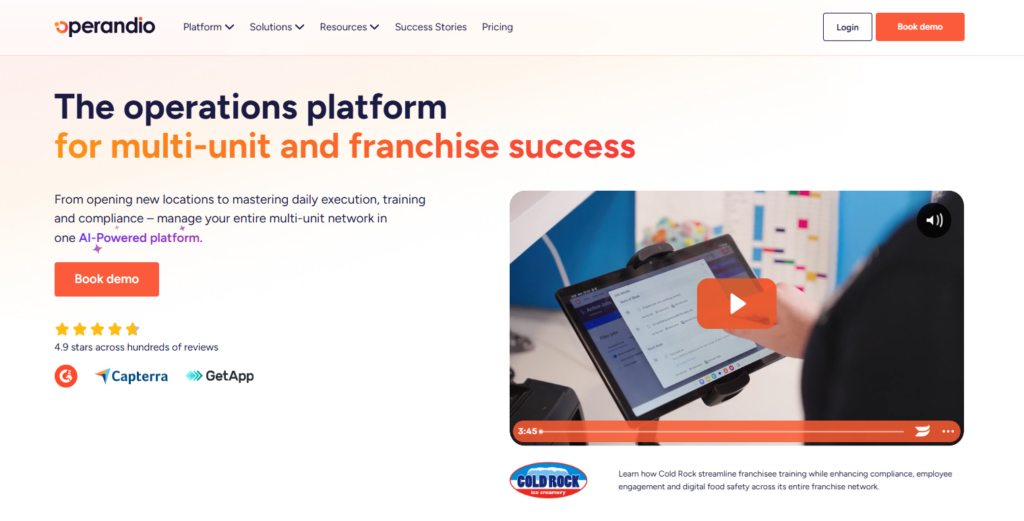
Operandio is the strongest fit here for multi-location and franchise businesses because it covers the full frontline operating model in one system.
It offers training, operations execution, communication, compliance, food safety, asset management, and incident management, which is closer to how frontline teams actually work than a single-purpose tool.
Its LMS is built for mobile-first frontline training, while the operations execution layer covers communications, SOPs, tasks, audits, and shared-tablet workflows.
Its food safety product adds HACCP checks, temperature monitoring, labeling, and corrective actions.
Operandio supports 70,000+ active users across 47 countries, with 2M+ audit steps completed and 1M+ corrective actions raised.
YOOBIC
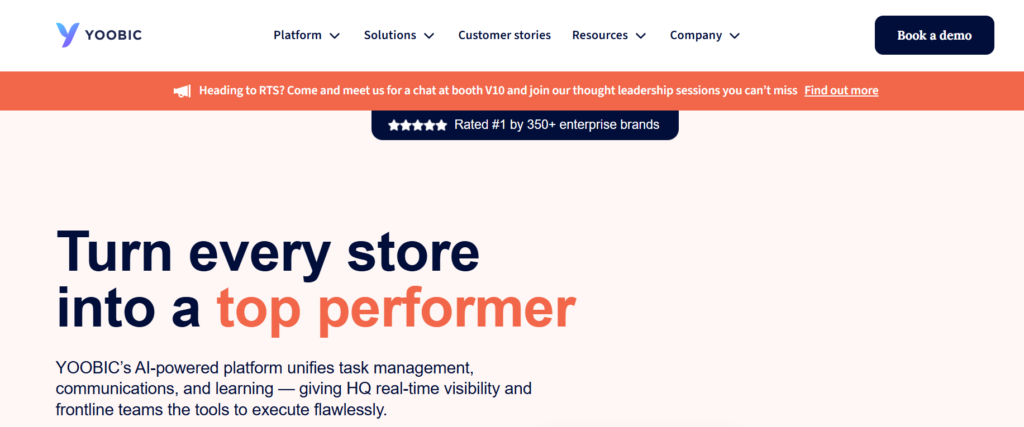
YOOBIC is a strong option if your world is store execution first. It is built around retail task management, communications, learning, store visits, audits, and merchandising.
The official site also highlights 200+ integrations and a pricing model based on locations or users, plus selected modules.
That makes it a credible choice for retail chains that want better field visibility and stronger store-level follow-through.
SafetyCulture
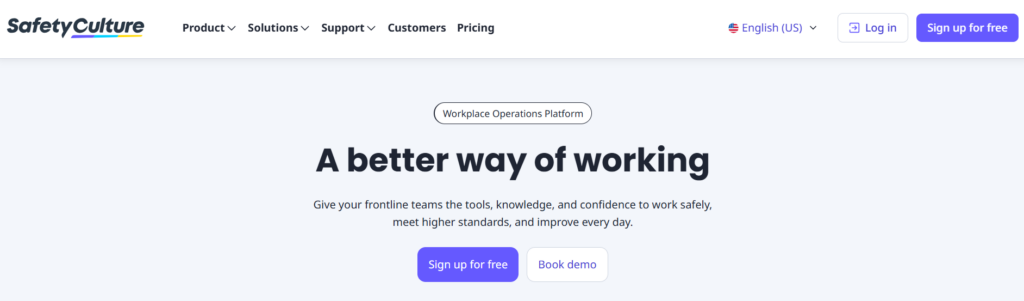
SafetyCulture is strongest when inspections, safety, issues, sensors, and flexible rollout are the priority.
It has expanded well beyond audits into assets, documents, onboarding workflows, communications, training, and analytics.
They offer a free plan and Premium full seats at $24 per user per month billed annually, plus lite and guest seat options.
It is a practical choice for operations teams that want flexibility and strong inspection workflows.
Beekeeper
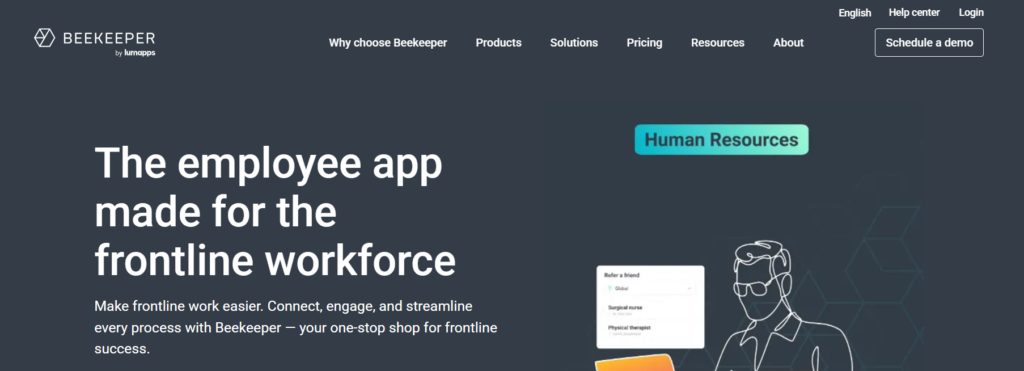
Beekeeper is a communication-first platform for frontline teams. The platform focuses on instant updates, tasks, schedules, paystubs, and AI-powered frontline support.
It is best suited to businesses that want one mobile hub for communication and employee access rather than a broader execution and compliance stack.
Manage Your Frontline Team More Effectively With Operandio
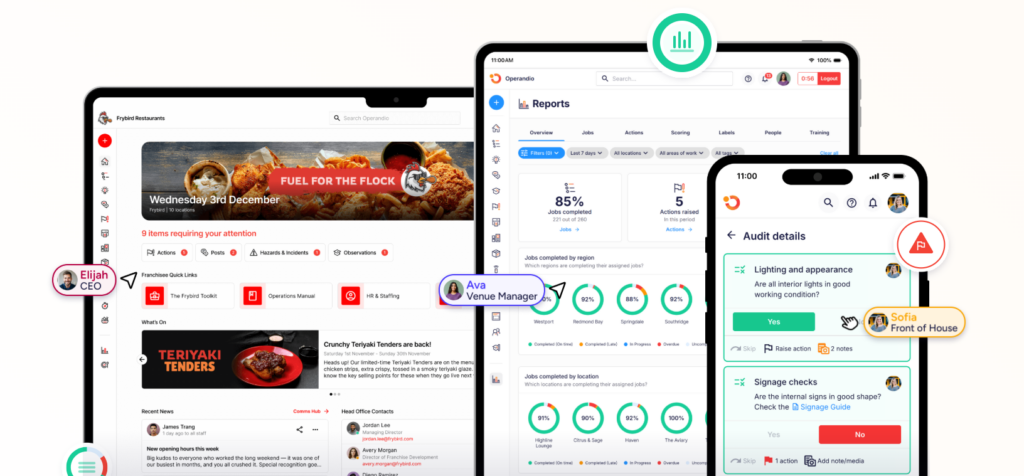
Managing frontline employees gets harder when standards, tasks, training, communication, and compliance proof live in different systems.
Managers spend more time chasing updates than coaching people, and HQ loses visibility across locations.
Operandio is built to fix that for multi-location and franchise operators by bringing operations execution, LMS, employee communications, SOPs, food safety, and reporting into one platform built for non-desk teams.
If you want a system that helps you hold staff accountable even when you’re not there, this is the platform to make it happen.
👉 Book a demo and see how Operandio fits your operating model.

FAQs
What counts as a frontline employee?
A frontline employee is someone whose work happens directly in service, operations, care delivery, production, or the customer environment rather than at a desk.
What is the difference between a frontline manager and a supervisor?
A supervisor usually focuses on immediate oversight during a shift. A frontline manager usually carries broader responsibility for performance, training, communication, compliance, staffing, and operational results.
How do you onboard new frontline employees effectively?
Use a structured 30-to-90-day plan with role-based training, clear sign-offs, shadowing, short coaching check-ins, and visible standards.
How do you manage performance without micromanaging?
Set clear standards, attach work to checklists and proof, coach weekly, and use corrective actions when something fails.