
- Platform
- Features
 Franchise & Multi-Unit ManagementCentralize oversight and streamline growth across your entire multi location network
 Learning ManagementTrain, verify, and reward your workforce with mobile-first education
 Operations ExecutionStreamlined operations ensuring brand standards, accountability and efficiency
 Asset ManagementOptimize equipment uptime through proactive maintenance and smart tracking
 Digital Food SafetyAutomate compliance and monitor quality with real-time digital precision
 Health & Safety Management (EHS)Mitigate workplace risks and streamline digital incident reporting and investigations
- Platform Essentials
 Powerful ReportingAlign leadership with role-based dashboards and deeper analytics
 Operandio IntelligenceAutomate content, analyze trends, and provide instant answers
 IntegrationsUnify your enterprise tech stack with real-time data
 IoT PlatformDetect anomalies and automate workflows with intelligent sensors
 Mobile & Shared Tablet AppsSecurely empower frontline teams with fast, offline-capable access
- Footer


 Not sure what you need?
Book in a call with the team
- Features
- Solutions
- By Industry
 RestaurantsQSR, fast food and multi-unit restaurants
 Hotels & ResortsHotels, resorts and extended stay hotels
 ChildcareEarly education, childcare, daycare and preschool
 EntertainmentTheme parks, family entertainment centers and play centers
 Fitness Centers & LeisureFitness centers, golf clubs, gyms and sports facilities
 RetailBig-box retailers, franchise stores and supermarkets
- By Use Case
- Operational ExcellenceStreamlined operations ensuring brand standards, accountability and efficiency
- Learning & DevelopmentTrain, verify, and reward your workforce with mobile-first education
- Franchise & Multi-Unit ManagementCentralize oversight and streamline growth across your entire multi location network
- Food Safety ComplianceAutomate compliance and monitor quality with real-time digital precision
- Asset Management & MaintenanceOptimize equipment uptime through proactive maintenance and smart tracking
- Health & Safety Management (EHS)Mitigate workplace risks and streamline digital incident reporting and investigations
- By Industry
- Resources
- Platform
- Features
- Franchise & Multi-Unit ManagementCentralize oversight and streamline growth across your entire multi location network
- Learning ManagementTrain, verify, and reward your workforce with mobile-first education
- Operations ExecutionStreamlined operations ensuring brand standards, accountability and efficiency
- Asset ManagementOptimize equipment uptime through proactive maintenance and smart tracking
- Digital Food SafetyAutomate compliance and monitor quality with real-time digital precision
- Health & Safety Management (EHS)Mitigate workplace risks and streamline digital incident reporting and investigations
- Platform Essentials
- Powerful ReportingAlign leadership with role-based dashboards and deeper analytics
- Operandio IntelligenceAutomate content, analyze trends, and provide instant answers
- IntegrationsUnify your enterprise tech stack with real-time data
- IoT PlatformDetect anomalies and automate workflows with intelligent sensors
- Mobile & Shared Tablet AppsSecurely empower frontline teams with fast, offline-capable access
- Footer
- Not sure what you need?
Book in a call with the team
- Features
- Solutions
- By Industry
- RestaurantsQSR, fast food and multi-unit restaurants
- Hotels & ResortsHotels, resorts and extended stay hotels
- ChildcareEarly education, childcare, daycare and preschool
- EntertainmentTheme parks, family entertainment centers and play centers
- Fitness Centers & LeisureFitness centers, golf clubs, gyms and sports facilities
- RetailBig-box retailers, franchise stores and supermarkets
- By Use Case
- Operational ExcellenceStreamlined operations ensuring brand standards, accountability and efficiency
- Learning & DevelopmentTrain, verify, and reward your workforce with mobile-first education
- Franchise & Multi-Unit ManagementCentralize oversight and streamline growth across your entire multi location network
- Food Safety ComplianceAutomate compliance and monitor quality with real-time digital precision
- Asset Management & MaintenanceOptimize equipment uptime through proactive maintenance and smart tracking
- Health & Safety Management (EHS)Mitigate workplace risks and streamline digital incident reporting and investigations
- By Industry
- Resources
What is the Purpose of a Learning Management System (LMS)?
Key Takeaways
- Traditional training breaks down when teams grow across locations, shifts, and managers. In frontline industries, turnover and consistency are constant sources of pressure.
- A good LMS helps standardize training, assign it by role, track completion, test understanding, and generate proof for managers, auditors, and compliance teams. The stronger platforms also support mobile learning, microlearning, and multilingual delivery for frontline teams.
- For multi-location and franchise businesses, the real win is connecting training to daily operations, so standards show up on shift, across every location. That is where an LMS tied to audits, checklists, SOPs, and corrective actions becomes much more useful than a standalone frontline training tool.
The real purpose of a learning management system is to make training consistent, trackable, scalable, and easier to manage.
An LMS gives you one place to assign learning, deliver content, measure progress, and prove completion.
For multi-location businesses, it also creates the structure needed to keep standards consistent across sites as the business grows.
Why Traditional Training Breaks Down as Teams Scale
When the team is small, informal training can survive on manager memory and good intentions. Once you add more sites, more shifts, and more turnover, that approach starts failing fast.
Knowledge becomes inconsistent
- One manager explains the process one way.
- Another skips steps.
- A third assumes the new hire already knows it.
That creates uneven execution. In restaurants, retail, hospitality, healthcare, and other frontline environments, that inconsistency translates to missed steps, service issues, safety risks, and location-to-location variation.
An LMS helps by making the same training available to the right people, in the right role, every time.
You lose visibility
You may know that someone attended a session. You may not know whether they completed the material, passed the quiz, acknowledged the policy, or need retraining.
Real users often point to reporting and compliance tracking as one of the most valuable parts of an LMS because it shows who is complete, who is overdue, and what evidence is available for reviews or audits.
Turnover keeps resetting the process
Training pressure gets worse when employee churn stays high. In the State of the Restaurant Industry report, 77% of restaurant operators said retaining employees is a significant challenge. Gallup’s 2026 State of the Global Workplace also found global engagement dropped to 20% in 2025, which carries major productivity costs.
When people leave often, relying on traditional training methods becomes even more expensive.
Training takes too much manager time
Without a training management system, managers chase completions, repeat the same explanations, answer the same questions, and manually document who finished what.
hat turns training into admin work. An AI LMS reduces that load by automating content creation, enrollments, reminders, and reporting, giving managers more time to coach performance instead of managing spreadsheets.
It gives managers more time to coach performance instead of managing spreadsheets.
See how Operandio automates training and reduces manager workload. Book a demo
LMS vs. SOP Systems: Understanding the Difference
These two categories overlap, but they are not the same.
| System | Main Job | Best For | Limitation |
| LMS | Delivering, assigning, tracking, and assessing training | Onboarding, compliance training, role-based learning, certifications | Often stops at training delivery |
| SOP system | Storing and controlling standard operating procedures | Policies, process documentation, version control, reference material | Does not always prove people learned or applied the process |
| Connected platform | Linking SOPs, training, tasks, audits, and follow-up | Multi-location operations that need consistency and proof | Usually broader than a standalone LMS |
In simple terms, an SOP system tells people what the standard is. An LMS helps teach it, test it, and track it.
For frontline businesses, the strongest setup connects both, because reading a procedure is not the same as being ready to do the work correctly on shift.
Core Purpose of an LMS
The purpose of an LMS becomes clearer when you stop thinking about courses as methods of training and start thinking about business outcomes you want to achieve.
Here’s what you need to focus on:
Standardize knowledge across every location
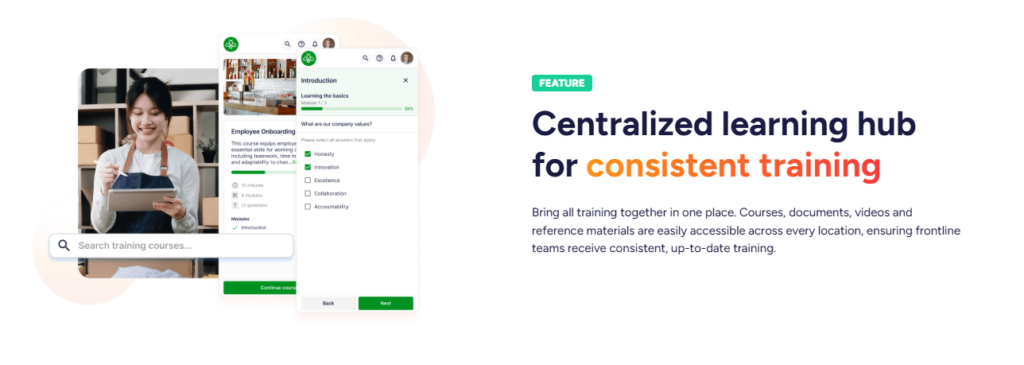
An LMS creates one source of truth for training.
That matters when you have multiple sites, rotating shifts, seasonal staff, franchisees, or high manager turnover. Everyone gets the same approved content, the same role-based path, and the same baseline expectations. Corporate LMS platforms like Operandio are systems that help companies organize, track, and manage employee onboarding, development, and compliance training.
Pro Tip: In multi-unit businesses, the value comes from consistency of rollout. If one region gets updated training two weeks earlier than another, standards can become difficult to uphold across locations. That’s why centralizing training, assessments, certifications, and pathways with a modern LMS can greatly impact your operations.
Speed up onboarding without losing quality
A good LMS helps new hires get job-ready faster.
Instead of waiting for one manager to have time, training can start immediately, follow a defined sequence, and include quizzes, videos, short modules, and assessments. LinkedIn’s Workplace Learning Report also highlights how learning supports retention and career progress, while career-focused organizations see stronger learning engagement and promotion outcomes.
This matters for frontline teams because ramp time affects labor, service quality, safety, and customer experience.
Note: Faster onboarding does not mean dumping more information on day one. It usually means shorter learning blocks, structured learning pathways, and training delivered close to the moment of work.
Find out why microlearning is the Learning Management System strategy QSRs can’t afford to ignore.
Prove compliance and reduce risk
In many businesses, training is part of compliance.
That includes food safety compliance, workplace conduct, privacy, health and safety, certifications, policy sign-offs, and recurring refreshers. An LMS gives teams a way to assign mandatory training, track deadlines, store completion records, and pull evidence when needed. Compliance training is also a major capability buyers actively look for in corporate LMS products.
For regulated or operationally heavy businesses, this proof matters almost as much as the training itself.
Compare the 3 Best SaaS Learning Management Systems.
Reduce dependency on individual managers
Without an LMS, training quality often depends on who is on shift.
That creates risk:
- Strong managers train well
- Weak or rushed managers skip details
- Busy managers postpone it
An LMS gives the business a repeatable system that does not disappear when one supervisor leaves. It protects training quality from manager variability and makes the organization less dependent on memory, paper checklists, or ad hoc handovers.
Support continuous learning, not one-time training
Many teams treat training like an event. Good LMS use turns it into an ongoing process.
LinkedIn found that 91% of L&D professionals say continuous learning is more important than ever for career success, and 88% of organizations are concerned about employee retention, with learning opportunities named as the top retention strategy.
That does not mean everyone needs long formal courses. In frontline businesses, it often means bite-sized refreshers, manager-led coaching support, and quick reinforcement around real tasks.
McDonald’s shared in the LinkedIn report that bite-sized learning in 13+ languages helped support frontline restaurant staff, reduce content overload, and improve performance.
Different Types of LMS Platforms and How They Work
Not every LMS works the same way. The main types include:
- Corporate LMS: Built for employee onboarding, compliance, skills development, and reporting across a business. Best for companies that need structured internal training.
- Academic LMS: Designed for schools, universities, and formal education settings. These focus more on classes, assignments, grading, and instructor-student workflows.
- Standalone LMS: Focused mainly on training delivery and tracking. Good if learning is the only problem you need to solve.
- Extended enterprise LMS: Used to train partners, customers, contractors, or franchise networks, not just direct employees.
- Frontline or mobile-first LMS: Built around phone and tablet access, shorter lessons, and easier use for deskless teams. This is especially important in hospitality, retail, restaurants, healthcare, and field operations. Recent frontline learning research found 60% of frontline workers surveyed want to access training on a mobile device, and 37% want to use their own phone.
The Gap Most LMS Platforms Still Don’t Solve
This is the part many buyers miss.
Most LMS platforms are good at delivering training, but they are not always good at making sure training shows up in day-to-day work.
Here’s what usually happens:
Training stays disconnected from daily operations
People complete the course, then go back to a workplace that runs differently.
If training is not tied to current SOPs, shift tasks, inspections, or operational standards, knowledge fades and bad habits return.
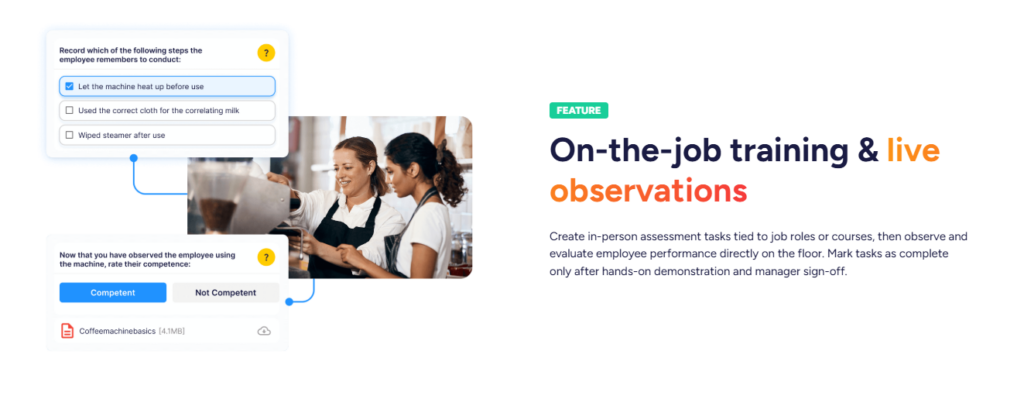
Completion does not equal competence
A checkmark is not proof of readiness.
Someone can finish a module and still struggle with the task in a real environment. That is why operational teams often need in-person assessments, observations, and follow-through, not just completions.
Content gets outdated faster than the work changes
- Processes change
- Products change
- Regulations change
- Promotions change
If training content is slow to update, the LMS can end up reinforcing old behavior instead of the current standard.
Pro Tip: Store SOPs, manuals, policies, and operational documents in a single knowledge base. Pay attention to version control and role-based permissions to safely train across locations.

Managers still cannot see the full picture
A standalone LMS may show course completion. It may not show whether poor audit scores, repeated incidents, or missed checklist steps point to a training gap.
That is why multi-location operators often need a broader platform that connects learning with execution, communication, corrective actions, and reporting.
How to Choose the Right Learning Management System
The best LMS is the one that fits how your teams actually work.
Role-based assignments and learning paths
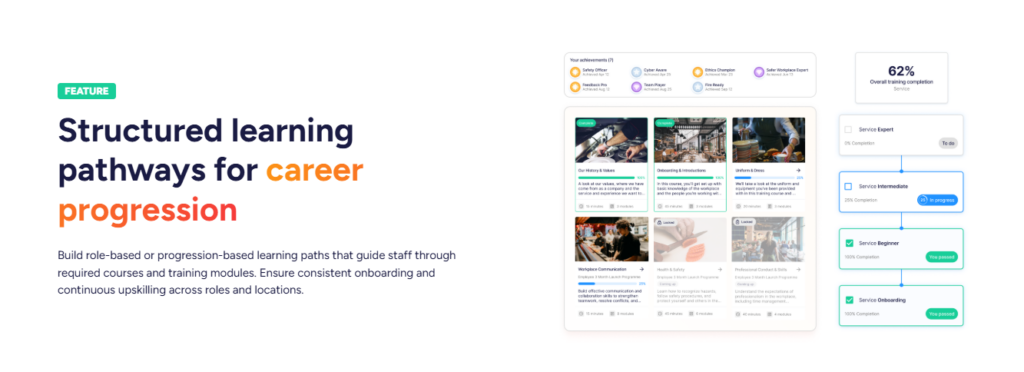
Look for a system that lets you assign training by role, location, brand, or job type.
Operandio offers role-based or progression-based learning paths that guide your staff through required courses and training modules.
That keeps content relevant and prevents one generic training library from becoming cluttered and ignored.
Mobile-first delivery
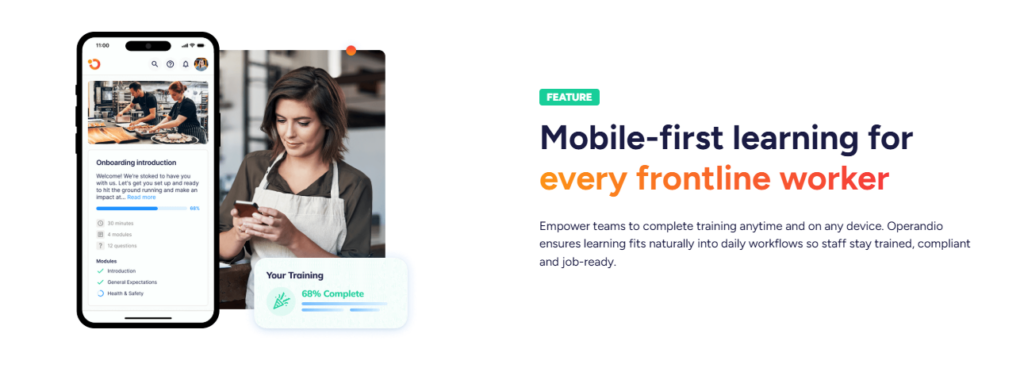
This matters a lot for frontline teams.
If staff need to hunt for a desktop login or wait until the end of a shift, completion rates will suffer.
Mobile access, short modules, and easy sign-in matter far more than flashy course design for many operators.
Reporting, compliance tracking, and audit proof
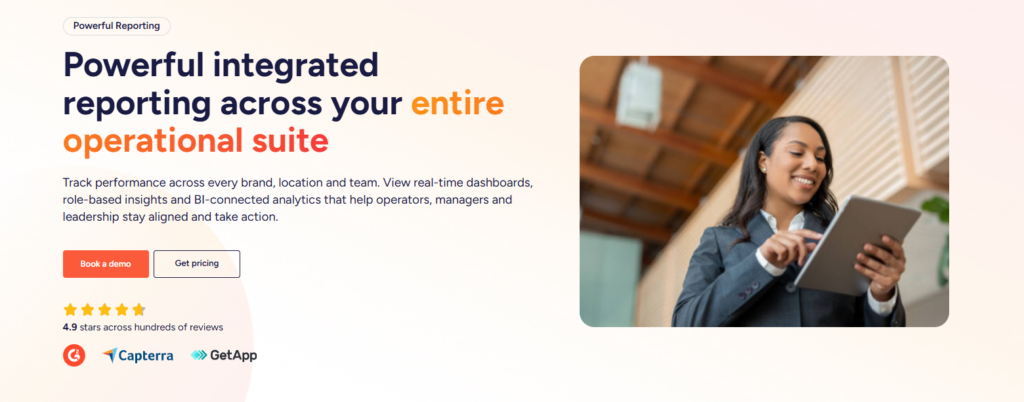
You need clean visibility into completions, overdue training, expiries, quiz results, and acknowledgments. This is why reporting is extremely important.
And is it also one of the biggest reasons businesses buy an LMS in the first place.
Connection to real operations
For franchise and multi-location businesses, this is often the difference between a useful LMS and a disconnected one.
The strongest platforms connect training to SOPs, checklists, audits, incidents, and follow-up actions so learning supports real operational consistency.
Turn Training Into Real-World Execution With Operandio
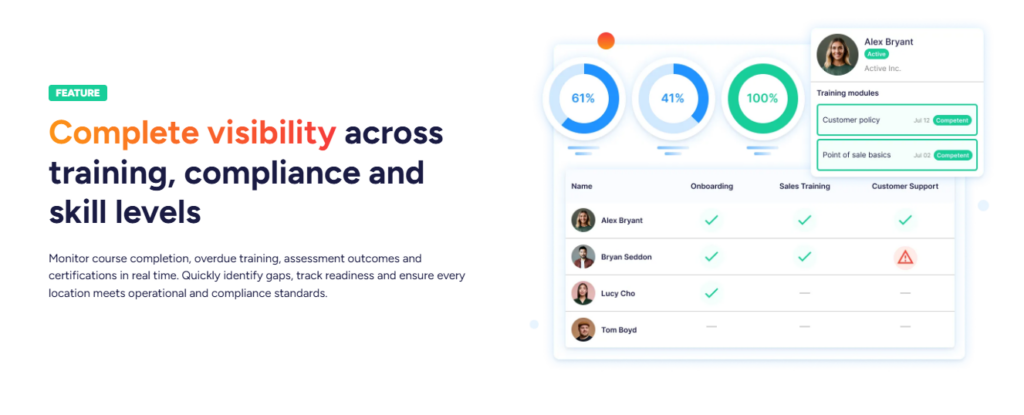
If you run multiple locations, manage frontline teams, or need to keep standards consistent across a franchise network, the bigger challenge is making training visible in day-to-day work.
That is where Operandio fits. It gives multi-location businesses a built-in LMS, then connects learning with SOPs, audits, digital checklists, corrective actions, communications, and reporting.
That makes it a stronger fit for restaurant groups, hospitality operators, retailers, healthcare teams, and franchise brands that need proof that standards were taught, understood, and followed.
Book a demo to see how Operandio can turn training into repeatable performance across every site.

FAQs
What is the point of LMS?
The point of an LMS is to deliver, manage, track, and improve training at scale so teams can onboard faster, stay compliant, and learn consistently.
What is a learning management system?
A learning management system is software used to create, assign, deliver, track, and report on training and learning programs.
How does an LMS support employee training?
It supports employee training by centralizing content, assigning courses by role, tracking completion, testing understanding, and giving managers reporting on progress and gaps.
Is an LMS only useful for large companies?
No. Smaller teams can use an LMS too, but the value usually grows fast when training becomes harder to manage across more people, roles, shifts, or locations.
Can an LMS replace SOPs?
No. An LMS can teach and track training, but SOPs still matter as the documented standard. The best setup connects both so teams know the process and can prove they learned it.