
- Platform
- Features
 Operations ExecutionStreamlined operations ensuring brand standards, accountability and efficiency
 Learning ManagementTrain, verify, and reward your workforce with mobile-first education
 Franchise & Multi-Unit ManagementCentralize oversight and streamline growth across your entire multi location network
 Digital Food SafetyAutomate compliance and monitor quality with real-time digital precision
 Asset ManagementOptimize equipment uptime through proactive maintenance and smart tracking
 Health & Safety Management (EHS)Mitigate workplace risks and streamline digital incident reporting and investigations
- Platform Essentials
 AI-Powered ToolsAutomate content, analyze trends, and provide instant answers
 IntegrationsUnify your enterprise tech stack with real-time data
 Powerful ReportingAlign leadership with role-based dashboards and deeper analytics
 IoT PlatformDetect anomalies and automate workflows with intelligent sensors
 Mobile & Shared Tablet AppsSecurely empower frontline teams with fast, offline-capable access
- Footer


 Not sure what you need?
Book in a call with the team
- Features
- Solutions
- By Industry
 RestaurantsQSR, fast food and multi-unit restaurants
 Hotels & ResortsHotels, resorts and extended stay hotels
 ChildcareEarly education, childcare, daycare and preschool
 EntertainmentTheme parks, family entertainment centers and play centers
 Fitness Centers & LeisureFitness centers, golf clubs, gyms and sports facilities
 RetailBig-box retailers, franchise stores and supermarkets
- By Use Case
- Operational ExcellenceStreamlined operations ensuring brand standards, accountability and efficiency
- Learning & DevelopmentTrain, verify, and reward your workforce with mobile-first education
- Franchise & Multi-Unit ManagementCentralize oversight and streamline growth across your entire multi location network
- Food Safety ComplianceAutomate compliance and monitor quality with real-time digital precision
- Asset Management & MaintenanceOptimize equipment uptime through proactive maintenance and smart tracking
- Health & Safety Management (EHS)Mitigate workplace risks and streamline digital incident reporting and investigations
- By Industry
- Resources
- Platform
- Features
- Operations ExecutionStreamlined operations ensuring brand standards, accountability and efficiency
- Learning ManagementTrain, verify, and reward your workforce with mobile-first education
- Franchise & Multi-Unit ManagementCentralize oversight and streamline growth across your entire multi location network
- Digital Food SafetyAutomate compliance and monitor quality with real-time digital precision
- Asset ManagementOptimize equipment uptime through proactive maintenance and smart tracking
- Health & Safety Management (EHS)Mitigate workplace risks and streamline digital incident reporting and investigations
- Platform Essentials
- AI-Powered ToolsAutomate content, analyze trends, and provide instant answers
- IntegrationsUnify your enterprise tech stack with real-time data
- Powerful ReportingAlign leadership with role-based dashboards and deeper analytics
- IoT PlatformDetect anomalies and automate workflows with intelligent sensors
- Mobile & Shared Tablet AppsSecurely empower frontline teams with fast, offline-capable access
- Footer
- Not sure what you need?
Book in a call with the team
- Features
- Solutions
- By Industry
- RestaurantsQSR, fast food and multi-unit restaurants
- Hotels & ResortsHotels, resorts and extended stay hotels
- ChildcareEarly education, childcare, daycare and preschool
- EntertainmentTheme parks, family entertainment centers and play centers
- Fitness Centers & LeisureFitness centers, golf clubs, gyms and sports facilities
- RetailBig-box retailers, franchise stores and supermarkets
- By Use Case
- Operational ExcellenceStreamlined operations ensuring brand standards, accountability and efficiency
- Learning & DevelopmentTrain, verify, and reward your workforce with mobile-first education
- Franchise & Multi-Unit ManagementCentralize oversight and streamline growth across your entire multi location network
- Food Safety ComplianceAutomate compliance and monitor quality with real-time digital precision
- Asset Management & MaintenanceOptimize equipment uptime through proactive maintenance and smart tracking
- Health & Safety Management (EHS)Mitigate workplace risks and streamline digital incident reporting and investigations
- By Industry
- Resources
Best 7 Quality Management Software for Businesses (2026)
Key Takeaways
- Operandio: Best for multi-location and franchise businesses that need quality management tied to real frontline work across audits, checklists, corrective actions, etc.
- SafetyCulture and GoAudits: Best for inspection-heavy teams that want to digitize audits fast and improve reporting without rolling out a full multi-location operating system.
- Jolt, Xenia, and Zenput: Best for operators focused on day-to-day execution. The right fit depends on whether you need food safety tools, facilities management, or enterprise rollout control.
Quality management software is not one category with one winner. The best platform depends on the kind of quality problem you need to control.
ASQ says only 31% of respondents fully understand the impact of quality costs on financial performance. In foodservice, FDA data found that well-developed food safety management systems were the strongest predictor of better compliance, with fewer out-of-compliance behaviors than less developed systems.
Best Quality Management Software: A Quick Overview
| Software | Best for | Standout feature | Price starting point |
| Operandio | Multi-location restaurants, hotels, retail, healthcare, childcare, and franchise groups | One platform for audits, checklists, corrective actions, SOPs, training, communication, food safety, and reporting | Custom pricing by locations/users/modules |
| SafetyCulture | Inspection-led teams across industries | Mobile inspections with issue capture and corrective action workflows | From $24/seat/month annually on Premium |
| Xenia | Multi-site operations teams that need audits plus facilities workflows | Combines audits, work orders, sensors, and frontline task management | Custom pricing per location on official pricing page |
| Jolt | Restaurants and foodservice operators | Checklists, temperature logs, labeling, and scheduling in one restaurant-first stack | $89.99/month on Capterra listing |
| Zenput (Crunchtime Ops Execution) | Enterprise restaurant and retail rollouts | Above-store visibility into task completion and issue follow-up | $40/month on Capterra listing |
| GoAudits | Fast-moving inspection and audit programs | Strong mobile audits, instant reports, and action plans | From $10/user/month annually |
| Ladle | Foodservice and retail operators that want audit and compliance tools | Suite approach with MeazureUp for audits and ComplianceMate for food safety monitoring | From $20 per feature/month on Capterra listing |
Operandio: Best for Quality Management Software Solutions
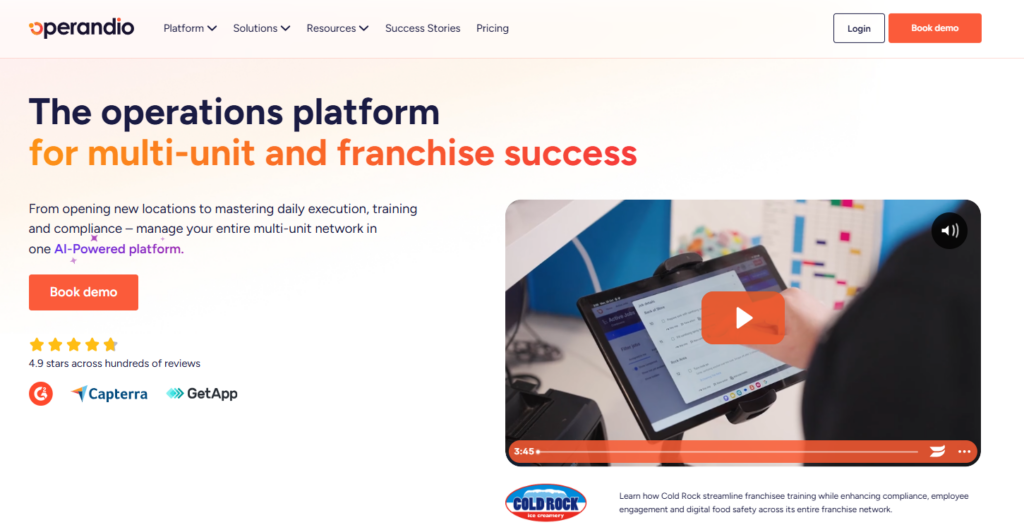
Operandio is the strongest fit in this list for multi-location businesses that need quality management to reflect directly on daily work, not sit in a separate admin system.
It brings together inspections and audits, recurring checklists, corrective actions, SOP and document control, learning management system, employee communication, reporting, food safety solutions, and shared-device workflows in one platform.
Key Features
Operandio stands out because it covers the full quality loop across a distributed business: define the standard, assign the work, verify completion, catch failures, trigger follow-up, train staff, and report performance by site, region, or brand.
Digital Audits and Evidence Capture
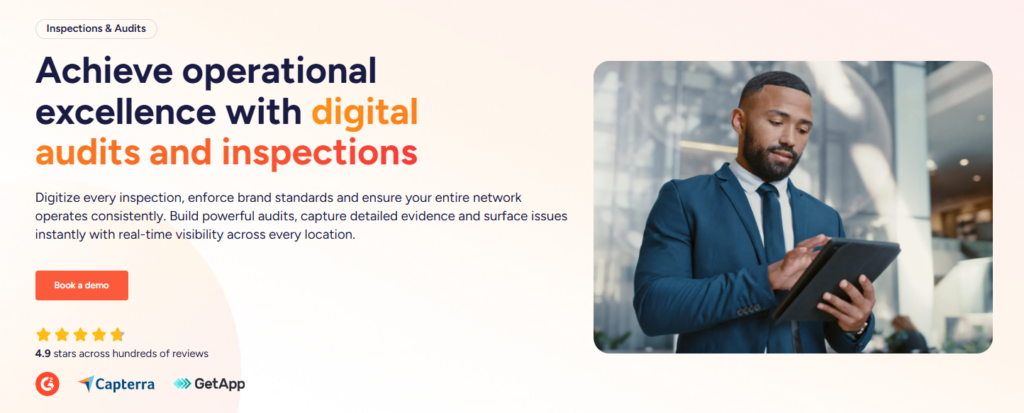
Operandio lets teams build digital audits for food safety, brand standards, facilities, safety, and quality. You can capture photos, timestamps, notes, and structured evidence, then roll results up across every location.
That matters for multi-unit operators because quality problems rarely sit in one store for long. Head office needs trend visibility, not a stack of PDFs.
Corrective Actions That Start Automatically
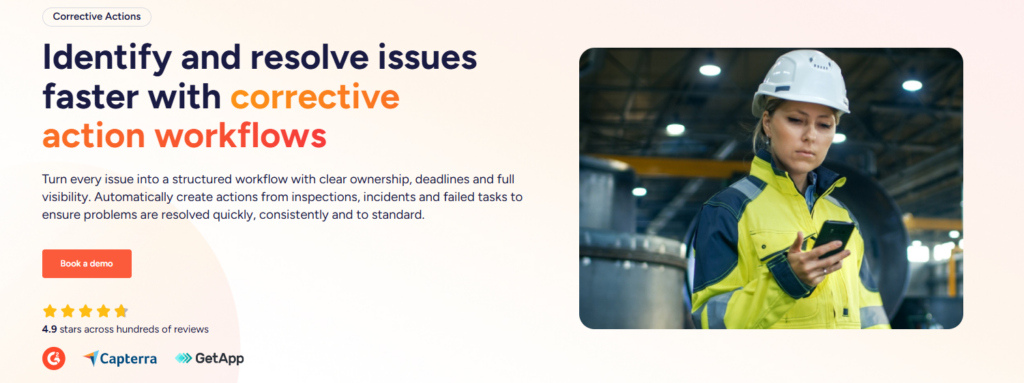
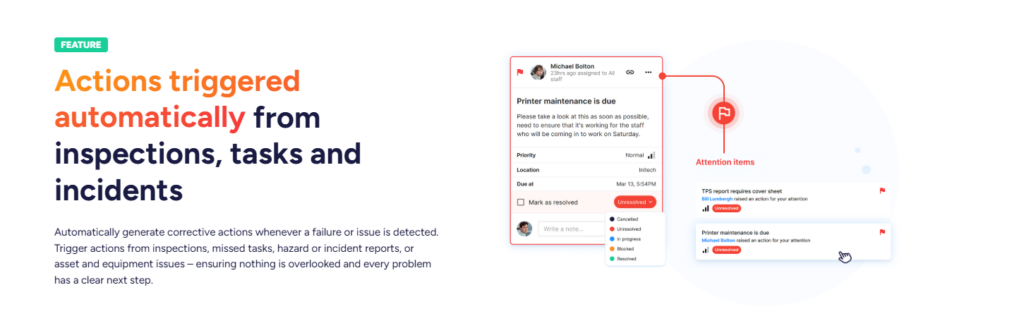
When a location fails an inspection, misses a task, logs an incident, or flags an equipment problem, Operandio can create a corrective action automatically. It assigns ownership, applies deadlines, escalates overdue work, and keeps a clear audit trail with comments, files, and evidence.
SOPs, Training, and Frontline Communication in One Place
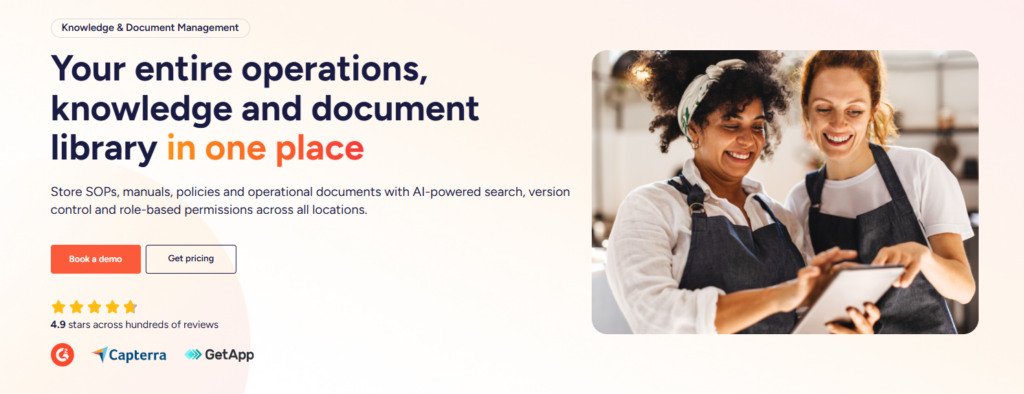
Operandio stores SOPs, policies, training content, and operational documents in a searchable knowledge base with version control and role-based access. It also supports frontline communication, acknowledgements, campaigns, and mobile-first training. That is a major advantage for franchise and multi-site operators because quality slips when teams cannot find the current standard or when updates never reach the floor.
Pricing
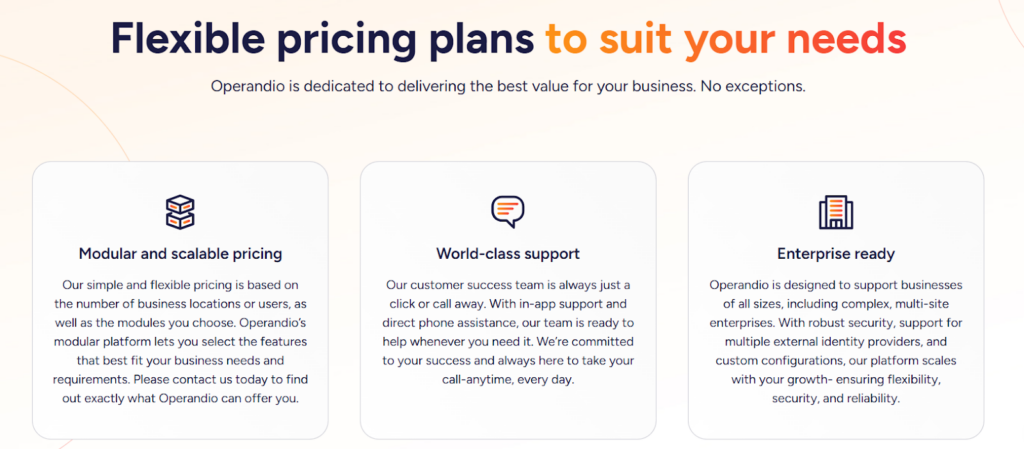
Operandio uses modular, quote-based pricing tied to the number of locations or users and the modules you need. It also offers a 14-day free trial, which starts after a demo booking.
| Pricing | Notes |
| Custom quote | Pricing is modular and flexible |
| Based on locations or users | You pay based on business size and selected modules |
| Module-based | You can choose from audits, tasks, LMS, docs, comms, reporting, food safety, integrations, and more |
Where Operandio Shines
- Built for multi-location operations: Operandio is designed around franchise and multi-site control, with audits, checklists, food safety, training, documents, communication, and reporting connected in one system.
- Stronger frontline adoption: Mobile and shared-tablet workflows make it practical for non-desk teams who need to complete work on shift, not at a back-office computer.
- Better proof of standards: It captures evidence, tracks overdue work, and closes gaps with corrective actions, which is what quality leaders actually need when standards start slipping across locations.
Where Operandio Falls Short
- More platform than a small single-site team may need: If you only want a basic digital inspection form, a lighter inspection app may feel easier to buy and faster to roll out.
- Less suited to lab and product-manufacturing QMS use cases: Companies that need deep regulated product workflows around validation, submissions, or life sciences document control.
Customer Reviews
Operandio scores 4.9/5 on Capterra (based on reviewed listings), where users are explicitly emphasizing multi-unit operations, training, audits/inspections, and compliance workflows as the best features.
Morgane M, HR Coordinator, Food Production: “Although we haven’t used Operandio for long, our experience has been very positive. The platform has already improved communication, task management, and training processes.”
Amanda P, Manager, Culinary Community, Facilities Services: “The Operandio system and team are the best around; no question has been unanswered. I would personally recommend them to anyone.”
Who Operandio Is Best For
- Best for: Operations, compliance, food safety, and L&D leaders in franchise and multi-location businesses who need to roll out standards, track adoption, and see what is happening at every site in real time.
👉Book a demo with Operandio to see how audits, SOPs, training, corrective actions, and reporting can run in one platform.
SafetyCulture: Best for Inspection-Heavy Teams
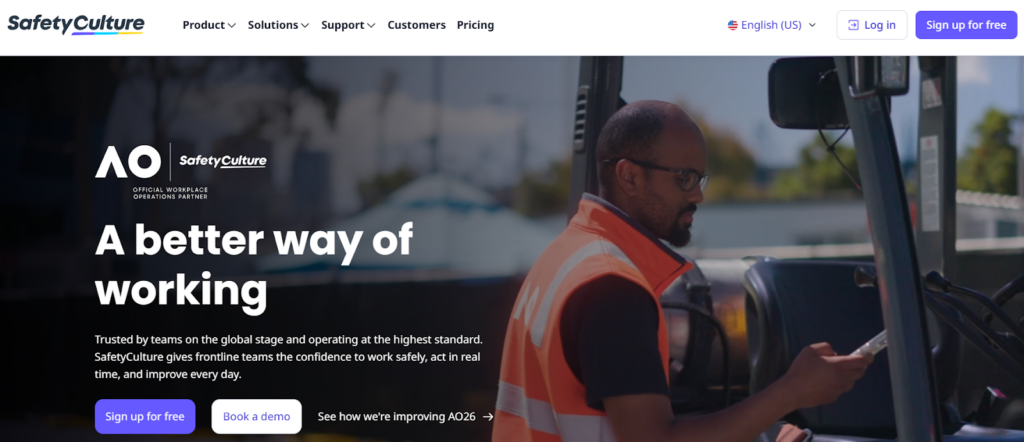
SafetyCulture is a strong choice for businesses that want to digitize inspections, capture issues fast, and improve visibility without adopting a broader franchise or multi-location operations platform. It is widely used for mobile inspections and issue tracking, and its strength is flexibility across many industries.
Key Features
- Mobile inspections: Teams can digitize inspections and standardize evidence capture.
- Issue capture and follow-up: The platform is built around inspections, issue capture, and corrective action workflows.
- Templates and flexibility: Reviewers regularly praise checklist customization and mobile execution.
Pricing
| Pricing | Notes |
| Free | Up to 10 users |
| Premium | From $24/seat/month billed annually |
| Enterprise | Custom quote |
| Training add-on | Premium training starts at $5 per learner/month, with at least one admin at $24/seat/month |
Where SafetyCulture Shines
- Easy starting point: Good for teams moving off paper who want quick wins in inspections and actions.
- Cross-industry flexibility: It works well across many inspection-led environments, not only foodservice or retail.
- Strong review volume: It holds a 4.6/5 rating on Capterra from 253 reviews.
Where SafetyCulture Falls Short
- Less purpose-built for franchise operations: It is strong on inspections, but it is not positioned as an end-to-end multi-location operating system for standards, training, and communications.
- Reporting limits come up in reviews: Some users mention bugs, sync delays, and limited report customization.
Customer Reviews
Toby B, Quality Assurance and Compliance Manager, Food Production: “The constant product development they are doing to the platform and how they genuinely bring what they say they are going to do to life.”
Joshua H, Network Engineer, Information Technology and Services: “The main drawback, a cap of three mobile devices per user, means logging out (again and again) just to switch devices.”
Who SafetyCulture Is Best For
- Best for: Teams that mostly need inspections, issue capture, and mobile reporting, without needing a full frontline operating stack.
Xenia: Best for Multi-Site Operations With Facilities Complexity
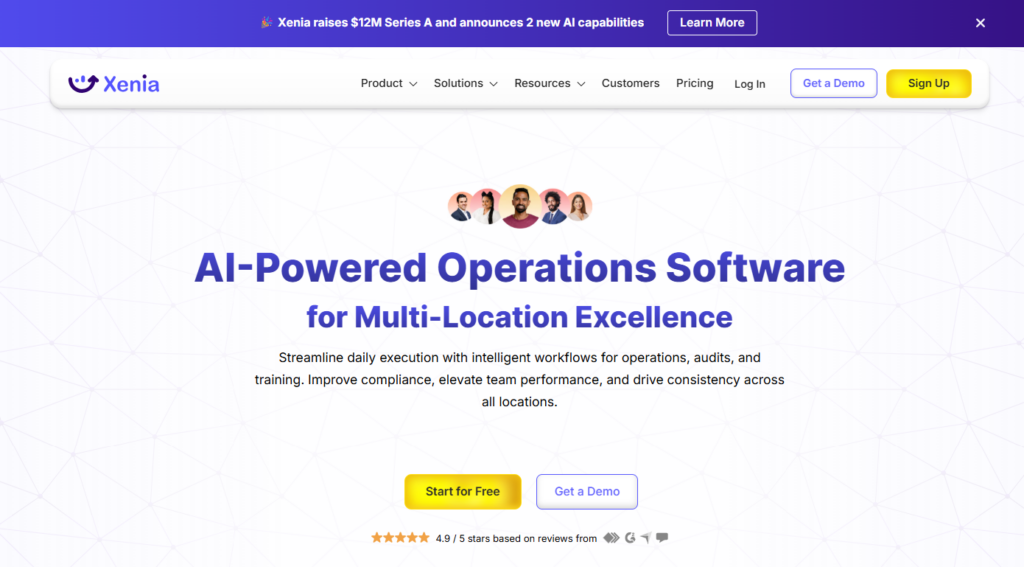
Xenia is a strong option for teams that need quality, operations, and facilities workflows in one platform. It combines checklists, audits, work orders, asset tracking, food prep label printing, and continuous monitoring, which makes it appealing for restaurant, retail, and facilities-led teams managing multiple sites.
Key Features
- Digital checklists and audits: Core inspection and task execution tools for frontline teams.
- Work orders and facilities ticketing: Better fit than many audit-first tools if equipment and maintenance are part of the quality problem.
- Sensors and food prep labeling: Useful for operators who want food safety and facilities monitoring in the same system.
Pricing
| Pricing | Notes |
| Basic | Custom pricing per location |
| Pro | Custom pricing per location |
| Enterprise | Talk to salesAdd-ons listed separately |
Where Xenia Shines
- Good blend of ops and facilities: Better fit than pure inspection tools when work orders matter.
- Strong early customer sentiment: Reviewers frequently mention the interface, mobile app, and onboarding.
- Multi-unit fit: One reviewer specifically highlighted dashboards for multi-unit operations.
Where Xenia Falls Short
- Terminology and UI learning curve: Some users say the interface can feel overwhelming at first.
- Training depth is not its main story: Even positive reviewers note they do not use it as a training platform.
Customer Reviews
Sean P, Corporate Training Manager, Food & Beverages: “Easy, fast, efficient, and great support. If you don’t like something, say something and the Xenia team will make it right, even if that means building out something custom for your needs.”
Sam C, General Manager, Hospitality: “The user interface can be a bit overwhelming for someone new to this type of software. Having a place to view all archived reports/tasks will make this software more usable for record-keeping over a long period of time.”
👉For a deeper dive, check out Best Xenia Alternatives.
Who Xenia Is Best For
- Best for: Multi-site operators who need quality workflows tied closely to facilities, maintenance, and frontline execution.
Jolt: Best for Restaurants Needing Structured Daily Execution
Jolt is built for restaurant and foodservice operators that need structure around checklists, temperature logs template, food labeling, and daily accountability. It is a practical choice for teams where quality management lives inside shift routines and food safety tasks.
Key Features
- Checklists and recurring tasks: Helps teams standardize daily work.
- Temperature monitoring and logs: Useful for HACCP-style food safety workflows.
- Food labeling and scheduling: Supports restaurant operations beyond inspections alone.
Pricing
| Pricing | Notes |
| $116/month per location | No cost-per-user pricing on listed self-serve page |
| $99 setup fee | Promotional setup fee shown on page |
| Custom quote available | Sales team can scope broader packages |
Where Jolt Shines
- Restaurant-specific workflows: Strong fit for teams that need food safety and routine execution in one place.
- Large review base: It has significantly more review volume than many niche restaurant tools in this list.
- Clear accountability: Users frequently mention health inspection tasks, line checks, and corrective actions.
Where Jolt Falls Short
- Older interface and setup demands: Capterra’s review summary calls out dated UI and setup complexity.
- Bluetooth and app issues come up: Some users mention device-related connectivity problems and occasional app glitches.
Customer Reviews
Khilah B. Owner, Cosmetics: “The checklists and organization systems is what I liked the most about Jolt. There are ways to hold your team accountable with this platform in a professional way.”
Jarl W. Procurement, Systems and Training Manager, Hospitality: “Platform is dated, with very few updates experienced during the time that I administered the service. Outdated UX.”
Who Jolt Is Best For
- Best for: Restaurant operators who want a more structured daily execution layer around checklists, temperature logging, and food labeling.
Zenput (Crunchtime Ops Execution): Best for Enterprise Restaurant Rollouts
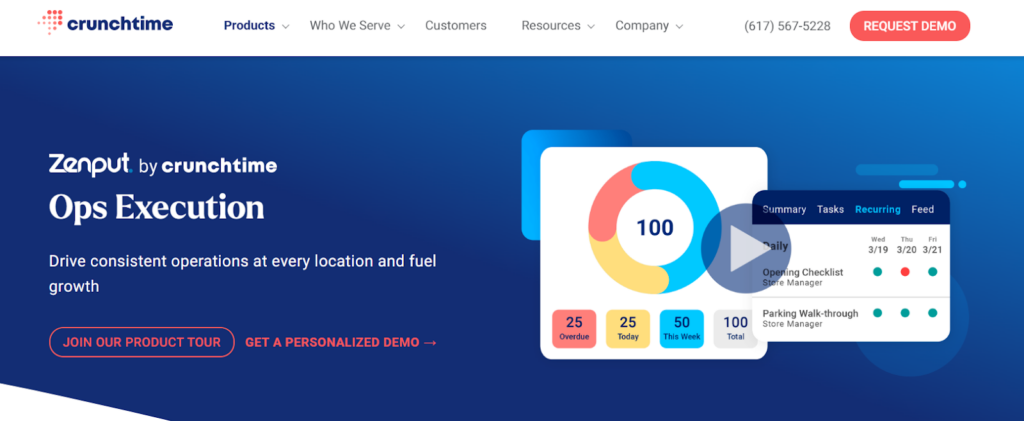
Zenput, now Crunchtime Ops Execution, is a solid fit for enterprise restaurant and retail brands that need above-store teams to push tasks, monitor compliance, and catch issues without constant store visits. It is built around rollout control and store execution visibility.
Key Features
- Store task visibility: Leaders can see what was done on time and what was done correctly.
- Recurring assignments and scheduling: Good fit for chain-wide rollouts and recurring work.
- Mobile accessibility and trend visibility: Reviewers mention operational trend tracking and full mobile access.
Pricing
Third-party sources report a starting price around $40/month, but real pricing typically depends on locations and requirements.
| Pricing | Notes |
| Reported from $40/month | Expect custom pricing based on scale and modules |
Where Zenput Shines
- Strong above-store control: Useful when field teams need to enforce execution across many locations.
- Enterprise restaurant fit: Better suited to large network rollouts than simpler checklist tools.
- Good review sentiment: 96% positive sentiment on Capterra.
Where Zenput Falls Short
- More focused on rollout execution than broad quality stack: It is strong on task visibility, but not as broad as platforms that combine training, documents, food safety, and communications more deeply.
- Some limits in scheduling and task depth: One reviewer noted limitations in scheduling and task management.
Customer Reviews
A Capterra reviewer said Zenput helped their team see operational trends and stay fully mobile, but also noted limits in scheduling and task management.
Who Zenput Is Best For
- Best for: Larger restaurant or retail brands that want better field visibility, task rollout control, and store execution tracking.
More Quality Management Software to Consider
GoAudits
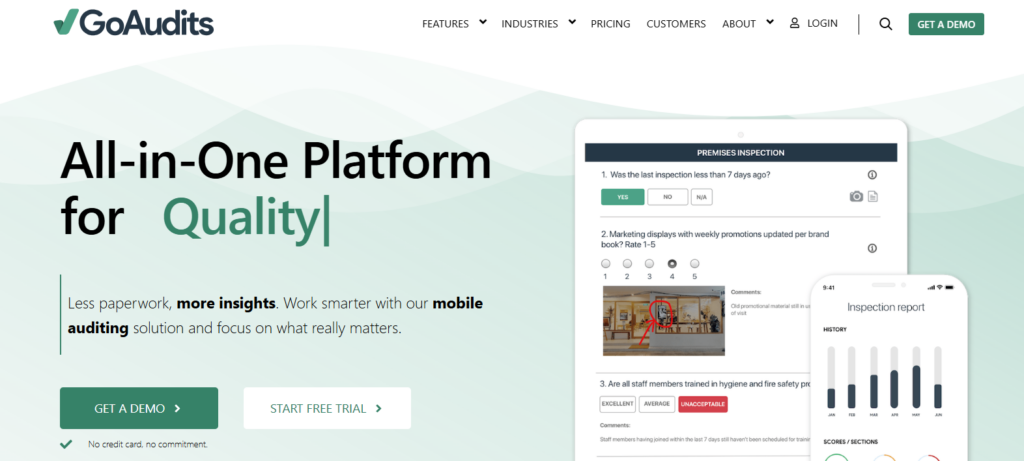
GoAudits is a strong fit for hospitality, retail, healthcare, and facilities teams that want a mobile-first audit app with instant reports, dashboards, and action plans.
Its pricing is clear, with a Starter plan from $10 per user per month annually, and it carries a 4.8/5 rating on Capterra from 143 reviews.
It makes a lot of sense when your quality program is still heavily inspection-led and you want faster rollout than a larger operations platform.
It is less compelling if you want deeper training, communication, or franchise-wide knowledge management in the same tool.
Ladle
Ladle works well for foodservice and retail operators that want a broader suite around audits, food safety, and pricing workflows.
Its MeazureUp product is built for field audits and daily checklists, while ComplianceMate focuses on food safety monitoring.
Capterra lists Ladle at 4.7/5 with pricing from $20 per feature per month. Reviewers highlight operational visibility and consistency, though some mention bugs when launching the app.
It is a better fit for food-led operations than for broad cross-industry quality programs.
Pro tip: Food safety operators should look beyond checklists alone. Temperature monitoring, prep labeling, incident logging, and corrective action tracking all matter if you want a stronger compliance setup.
How to Choose the Best Quality Management Software
The easiest way to choose well is to stop treating every QMS as the same category. A life sciences eQMS, a restaurant food safety platform, and a multi-location operational standards platform may all sit under “quality management software,” but they solve very different problems.
Match the Software to the Quality Problem
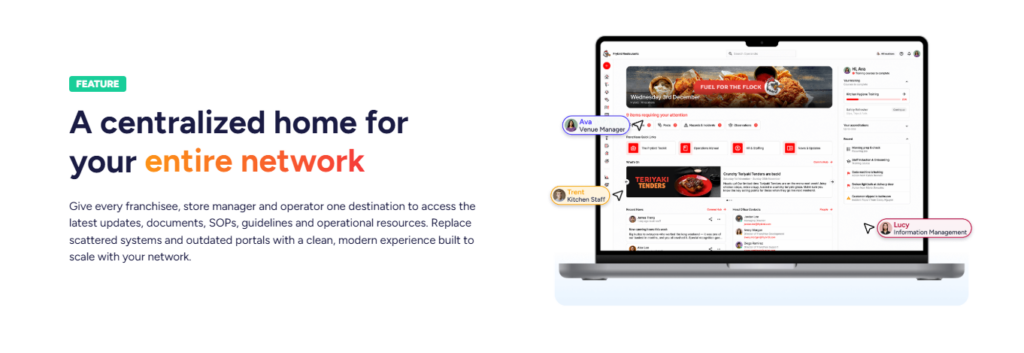
If your biggest issue is inconsistent execution across locations, choose a platform built for frontline teams and network-wide visibility. If your issue is regulated document control and CAPA inside product development, choose a true eQMS.
Operandio does the first job far better than a manufacturing-style QMS because it ties standards directly to tasks, audits, corrective actions, training, and communication across locations.
Pro tip: Don’t choose quality management software by feature count alone. Choose it by how easily a location manager can use it during a real shift, with real time pressure and real staff turnover.
Make Sure Teams Can Use It on the Floor
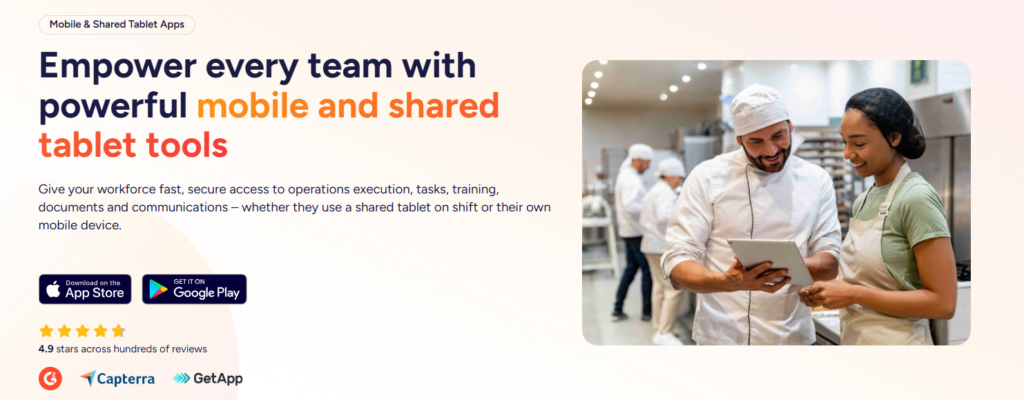
Quality software fails when the people doing the work avoid it. Mobile and shared-device workflows matter in restaurants, hospitality, retail, healthcare, and cleaning services because most staff are not sitting at desks.
Operandio is built for frontline use on phones and shared tablets, with simple checklists, deadlines, and acknowledgements.
Choose the platform your frontline teams will actually use, not the one that looks best in a feature grid.
Look for Proof, Ownership, and Follow-Through
A form is not quality management. You need evidence capture, escalations, audit trails, and a clear owner for every problem found. That is where corrective action workflows matter.
Operandio automatically triggers follow-up from failed inspections, missed tasks, incidents, and equipment issues, which makes it much easier to prove that problems were fixed instead of merely recorded.
Check Whether Training and SOP Access Are Part of the Workflow
Quality often breaks because the standard was updated, but the team never saw it, never understood it, or could not find it during the shift. LinkedIn’s Workplace Learning Report shows executives are worried about skills gaps, which is a good reminder that training cannot sit outside the operating workflow.
Operandio handles this well by combining version-controlled documents, searchable SOPs, frontline communication, and mobile training in the same platform.
Transform Your Quality Control With Operandio QMS
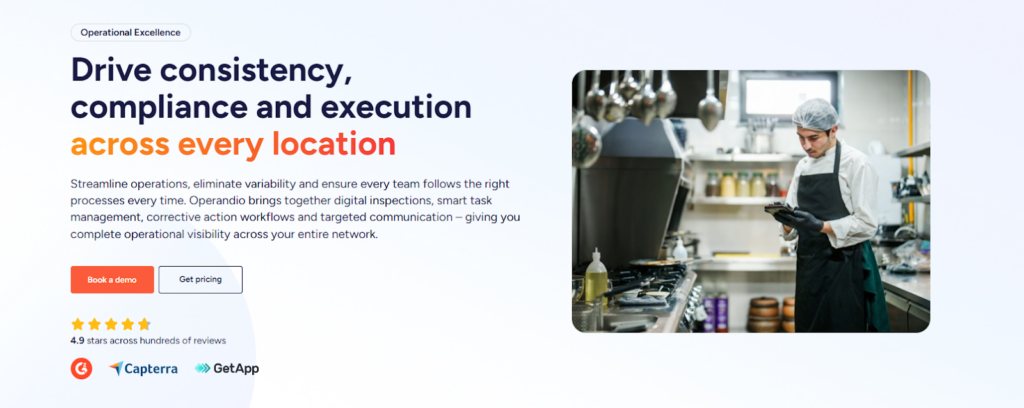
If you run a multi-location business, quality management is really an execution problem. You need to know what standard was assigned, who completed it, what evidence was captured, what failed, what follow-up was triggered, and whether every location is improving or slipping. Operandio is the best fit in this list for that job because it connects audits, checklists, corrective actions, SOPs, training, communication, food safety, and reporting in one system designed for frontline teams.
For inspection-led programs, SafetyCulture and GoAudits are solid options. But if your problem is getting standards followed across many locations, Operandio is the one I would put first.
👉Book a demo with Operandio and see how your audits, SOPs, training, and corrective actions can run together instead of living in separate tools.
