





Key Takeaways
- A food safety audit is a structured check of how a restaurant stores, prepares, handles, and documents food against defined standards. Multi-location businesses usually manage several audit layers rather than relying on one inspection.
- HQ should set internal audit frequency by risk, use the same questions and scoring rules across locations, calibrate auditors, and roll results up so repeat failures are visible across the network.
- Restaurant networks commonly deal with four audit types: location self-checks, HQ or district audits, brand-commissioned third-party audits, and regulatory health inspections.
- Audit scores only become useful when failed items lead to corrective actions with owners, deadlines, evidence, verification, and escalation.
A health inspector writes up cold holding at site 23. Three days later, HQ discovers the issue, even though a district audit two weeks earlier passed the same walk-in. This gap is exactly what a network food safety audit program is designed to prevent.
A food safety audit checks how a location stores, prepares, handles, and documents food against an agreed standard. Across multiple locations, HQ needs to run those checks in layers, score comparable sites consistently, and make sure findings are corrected on time.
This guide covers how HQ should run audits across a restaurant network, what outside auditors look for, and how to close corrective actions quickly.
What Is a Food Safety Audit, and How Is It Different for Multi-Location Businesses?
A food safety audit is a structured review of whether a restaurant’s people, processes, equipment, records, and food-handling practices meet defined food-safety standards.
Audits help identify failures in areas such as time and temperature control, employee hygiene, cross-contamination, allergens, sanitation, equipment, pest control, and recordkeeping before those failures contribute to a larger food-safety problem.
For a single restaurant, that may mean working through a restaurant audit checklist and correcting the findings.
For a multi-location business, the challenge is broader. HQ needs a repeatable program that tells it whether every location is operating against the same standard.
Restaurant networks typically deal with four layers of checks:
- Location self-checks
- HQ or district audits
- Brand-commissioned third-party audits
- Health department inspections
Certification schemes such as SQF, BRCGS, and FSSC 22000 are more commonly encountered across food-production and supply-chain programs. This guide focuses on the operational audits and inspections restaurant and food-service networks manage across their locations.
Food-safety terminology also comes up frequently in these programs:
- HACCP: Hazard Analysis and Critical Control Points
- TCS foods: Time/Temperature Control for Safety foods
- GFSI: Global Food Safety Initiative
- FSMS: Food Safety Management System
- PIC: Person in charge
For restaurant groups building formal food-safety controls, a food safety compliance platform can help connect these standards to day-to-day execution.
The Four Types of Food Safety Audit
The four audit layers serve different purposes. A daily check catches a problem during the shift, while an HQ audit asks whether locations consistently follow the brand standard. Independent and regulatory inspections add external scrutiny.
| Audit Type | Who Runs It and How Often | What It Is For |
|---|---|---|
| Location self-check | PIC or location manager; daily, by shift, or at defined control points | Catch immediate food-safety failures during normal operations |
| HQ or district audit | Regional, operations, QA, or food-safety team; cadence set by brand risk | Compare locations against one internal standard and identify recurring gaps |
| Brand-commissioned third-party audit | Independent auditor; frequency set by the brand or audit program | Provide independent assessment of food safety and agreed brand standards |
| Health department inspection | State or local regulator; frequency set by jurisdiction and risk | Verify compliance with adopted food-safety laws and regulations |
Type 1: Location Self-Checks
Self-checks happen closest to the work and should catch problems before they survive an entire shift.
Managers or the PIC may check refrigerator temperatures, hot holding, cooling, sanitizer concentration, handwashing facilities, cleaning completion, labels, pest evidence, or other high-risk controls.
Frequency depends on the control. Some checks happen at opening or closing, while temperature and food-production checks may occur several times during service.
A failed self-check should trigger immediate action where food safety is at risk. The value is speed: the location can discard affected food, correct a sanitizer mix, move product, retrain an employee, or call maintenance before the issue reaches an external inspector.
Type 2: HQ or District Audits
HQ audits test whether a location is following the company’s food-safety and operating standards consistently.
In a franchise network, a franchisor auditing an independently owned franchisee closely matches a second-party audit. In company-owned networks, the same activity is more accurately described as an internal audit. Operationally, both need similar governance.
Regional managers, food-safety specialists, QA teams, or trained district auditors may review food handling, documentation, cleaning, equipment, training, and brand-specific controls.
The frequency should reflect risk rather than convenience. A site with complex food preparation, recurring failures, or a poor compliance history can warrant more frequent audits than a consistently high-performing lower-risk location.
Type 3: Brand-Commissioned Third-Party Audits
Some restaurant brands use an independent company to assess locations against a defined food-safety or brand-protection program.
For example, brands that contract EcoSure can receive assessments designed around their own program priorities. These are separate from regulatory health inspections.
A third-party auditor may review the same areas HQ monitors internally, including temperatures, employee hygiene, contamination controls, sanitation, equipment, pest activity, and records.
Frequency, scoring, and follow-up depend on the individual program. A poor result may trigger corrective actions, additional training, internal escalation, or a follow-up visit under the brand’s rules.
If your brand uses EcoSure, this guide to EcoSure inspections covers that program in more detail.
Type 4: Health Department Inspections
Health department inspections are regulatory inspections conducted by the authority responsible for food establishments in that jurisdiction.
Inspectors evaluate the restaurant against the food-safety rules adopted locally. Depending on the jurisdiction and severity of the violation, findings can lead to required corrections, reinspection, penalties, permit action, or closure.
The FDA Food Code itself is a model used by jurisdictions to develop or update their own requirements. The 2026 edition therefore does not automatically become law in every U.S. location when FDA publishes it.
This distinction is important for multi-state restaurant groups: HQ can set one internal standard, but local regulatory requirements still need to be mapped and maintained by jurisdiction.
Second-Party Audits: How HQ Should Run Food Safety Audits Across Locations
A network audit program needs four things: risk-based cadence, one scoring model, calibrated auditors, and network-level reporting. Without those controls, HQ gets a collection of audit scores, not a reliable view of food-safety performance.
Best Practice 1: Set Audit Frequency by Risk
Do not give every location the same audit cadence simply because it is easier to schedule.
FDA’s risk-based inspection framework provides a useful starting model. Its Annex 5 example ranges from one routine inspection per year for lower-risk operations to four for the highest-risk category, with quick-service operations appearing in Category 2 and more complex full-service operations in Category 3.
FDA also recommends considering compliance history, specialized processes, food prepared in advance, number of people served, complaints, and highly susceptible populations when adjusting frequency.
HQ can apply the same logic internally. Establish a baseline cadence, then increase audits after events such as repeated food-safety failures, management turnover, a poor external inspection, unresolved corrective actions, or a major process change.
Best Practice 2: Use One Audit Form and One Scoring Model
A score is only comparable when every auditor is measuring the same thing the same way.
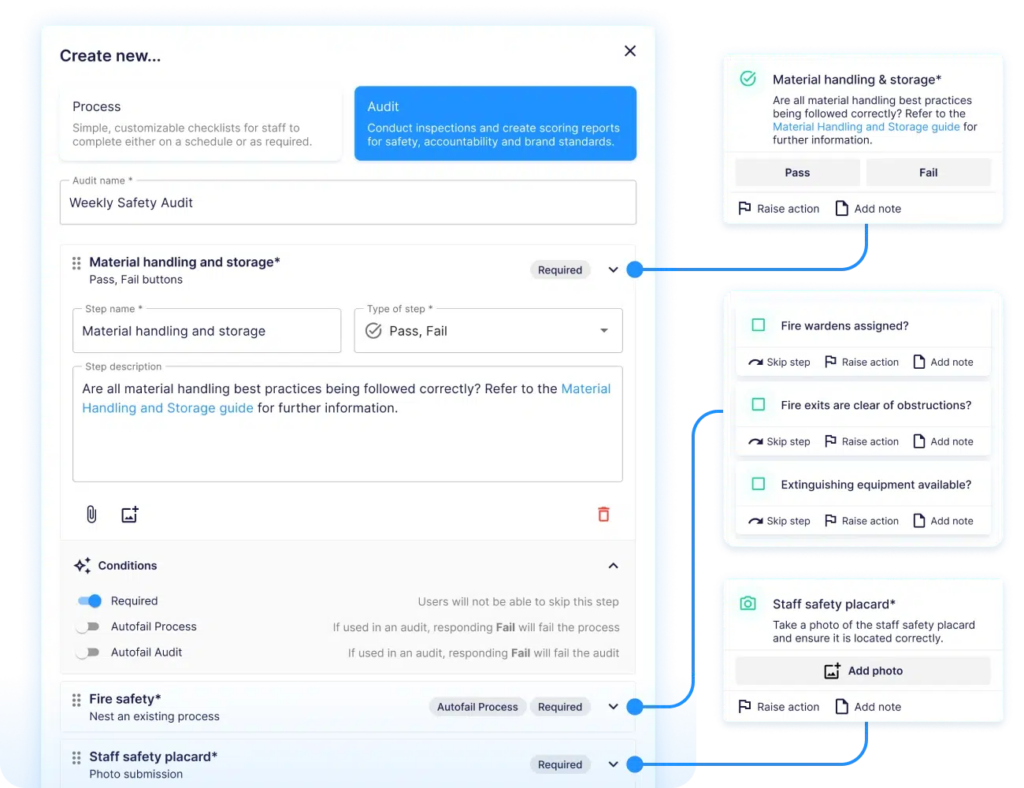
Use one core audit form across the network with consistent:
- Question wording
- Severity categories
- Scoring weights
- Evidence requirements
- Pass or escalation rules
Local regulatory requirements can be layered on where necessary, but the brand standard should remain recognizable across locations.
Avoid creating a scoring model in which one district deducts heavily for a failed cold-holding check while another treats the same failure as a minor issue, as this makes network averages misleading.
Operandio’s Inspections & Audits lets multi-location operators build standardized digital inspections, capture photos and other evidence, and track scores across sites.
Best Practice 3: Calibrate the People Conducting Audits
Even a good checklist produces unreliable data if auditors interpret it differently.
Calibration means testing whether two auditors looking at the same condition reach the same finding and severity.
HQ can run:
- Joint audits
- Photo-based scoring exercises
- Periodic calibration sessions
- Reviews of disputed findings
- Score comparisons between auditors
Pay extra attention to questions requiring judgment rather than a simple pass/fail reading.
If one district routinely scores 10 points higher than another, investigate whether the difference is operational or caused by auditor interpretation.
The goal is not identical personalities. It is consistent application of the brand standard so head office can compare locations with confidence.
Best Practice 4: Roll Results Up by Location, Region, and Finding Type
Do not let each completed audit disappear into a PDF or spreadsheet.
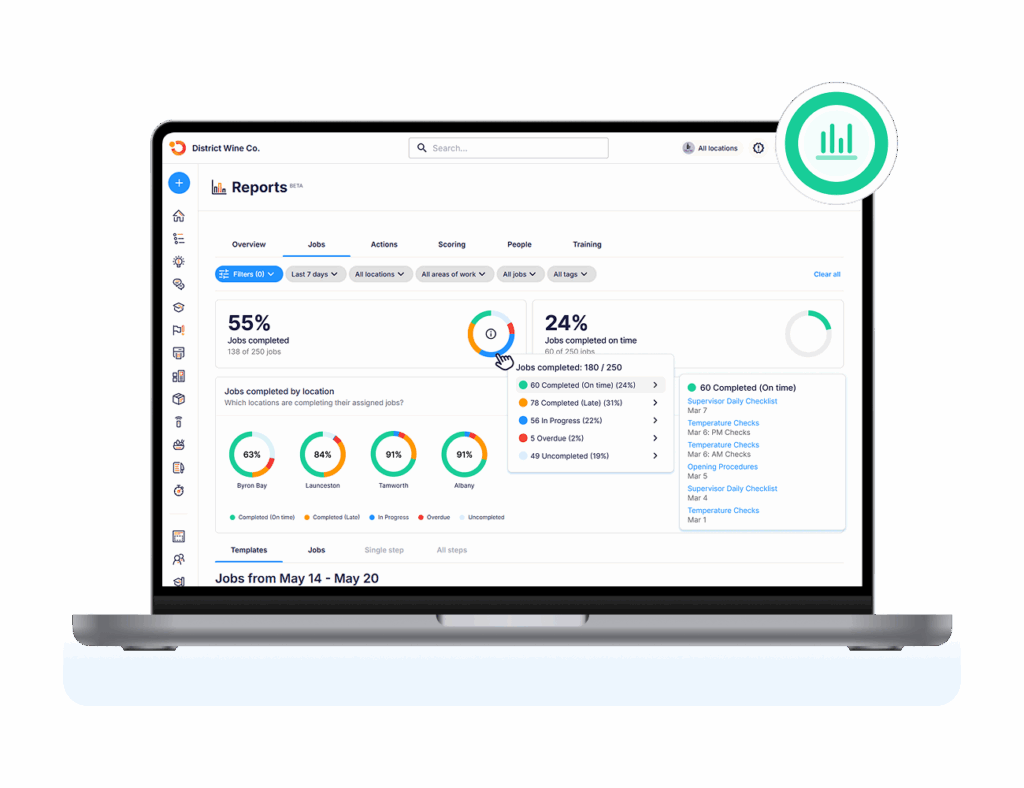
HQ should be able to see:
- Audit score by location
- Failed questions
- Finding severity
- Repeat failures
- Corrective-action status
- Regional trends
- High-risk categories
A single failure tells you what happened at one moment. Repeated cold-holding failures across six locations point to a network problem that may require equipment review, retraining, or a change in process.
Use reporting to identify where follow-up should be concentrated instead of treating every location equally.
Operandio’s operational reporting can compare audit scores, completion rates, recurring issues, and other operational data across locations, regions, concepts, and brands.
Third-Party Audits: What Independent Auditors and Health Inspectors Look For
Independent auditors and health inspectors may work against different standards, but they look for many of the same food-safety controls: whether employees handle food safely, critical temperatures stay within limits, facilities are sanitary, and records show those controls happen consistently.
The exact checklist depends on the third-party program or local jurisdiction.
| Area | What They Look At | Evidence They Ask For |
|---|---|---|
| Time and temperature | Cold/hot holding, cooking, cooling, reheating, thermometer use | Temperature logs, sensor history, cooling records |
| Employee health and hygiene | Handwashing, illness reporting, glove/utensil use, PIC knowledge | Illness policy, training records, certifications |
| Cross-contamination and allergens | Raw/RTE separation, storage, allergen cross-contact, date marking | SOPs, labels, allergen procedures |
| Cleaning and sanitization | Food-contact surfaces, warewashing, sanitizer strength | Cleaning schedules, sanitizer checks, completed logs |
| Facility, equipment, and pests | Equipment condition, waste, pest evidence, physical facilities | Maintenance records, pest reports, repair history |
| Management systems and records | Training, routine monitoring, previous findings, corrective actions | Audit history, food-safety records, corrective-action evidence |
Check 1: Time and Temperature Control
Temperature controls deserve heavy weight in a restaurant food safety audit.
FDA data from fast-food and full-service restaurants found cold holding out of compliance in 62% and 80% of observations respectively. Cooling was out of compliance in 59% and 69%.
Auditors may check TCS food temperatures directly, review cold- and hot-holding practices, inspect cooling records, and confirm thermometers are available and used correctly.
If a reading fails, the response depends on the food and risk. Teams may need to discard or relocate product, repair equipment, document the corrective action, and verify the temperature returned to an acceptable range.
Check 2: Employee Health, Hygiene, and Training
Auditors watch what employees actually do, particularly handwashing, glove and utensil use, illness reporting, and whether the PIC understands required food-safety controls.
FDA’s restaurant study found proper handwashing out of compliance in 59% of fast-food and 74% of full-service observations.
The 2026 FDA Food Code model also adds a requirement for a written employee illness policy that is maintained and available. The change becomes relevant as individual jurisdictions adopt the new edition. FDA summarizes the update in this report.
HQ should therefore make sure locations can produce current illness policies, training and certification records, and evidence that employees understand the procedures relevant to their role. This guide to food safety certificate compliance covers the recordkeeping side in more detail.
Check 3: Cross-Contamination, Allergens, and Safe Food Handling
Auditors look at how food moves through storage, preparation, cooking, holding, and service.
Common checks include separation of raw and ready-to-eat food, date marking, safe storage, clean utensils, and controls that reduce allergen cross-contact.
They may also ask employees to explain the process used for an allergen-sensitive order or inspect labels and procedures to see whether the written standard matches actual practice.
When the same handling failure appears across locations, HQ should look beyond retraining one employee. The underlying problem may be the SOP, kitchen layout, labeling process, equipment, or how the standard was communicated.
For allergen controls specifically, use a documented allergen-awareness process that locations can train and audit consistently.
Check 4: Cleaning, Equipment, Pest Control, and Records
A food safety audit also tests whether the environment supporting food preparation is under control.
Auditors may inspect food-contact surfaces, sanitizer concentration, warewashing, refrigeration, equipment condition, waste areas, pest evidence, and general facility maintenance.
They also look at records because a clean kitchen at 10 a.m. does not prove the process worked all month. Cleaning logs, pest reports, maintenance history, training records, temperature logs, and previous corrective actions show whether controls are routine.
The 2026 model Food Code also introduces written Food Safety Management System requirements for covered establishments within four years of a jurisdiction adopting the edition, subject to its provisions and exemptions.
For HQ teams formalizing those controls, this guide to building a food safety management system explains how procedures, monitoring, training, and follow-up fit together.
How to Close Corrective Actions Fast: 4 Best Practices
Corrective actions close faster when the failed audit item becomes an assigned action immediately, with an owner, a deadline based on risk, evidence of the fix, and someone responsible for verifying completion.
The FDA model Food Code generally expects Priority and Priority Foundation violations to be corrected during the inspection. Where the regulator allows more time, the model caps extensions at 72 hours for Priority items and 10 calendar days for Priority Foundation items. Core items generally have a correction deadline no later than 90 days.
HQ can set tighter internal targets.
| Finding Severity | Suggested Brand Deadline | Proof and Verification |
|---|---|---|
| Priority/immediate food-safety risk | Correct immediately; upload closure evidence within 24 hours | Photo, temperature/readout, disposal record; manager or regional verifier |
| Priority Foundation | Within 3 days | Photo, updated record, repair or training evidence; independent verification |
| Core | Within 30 days | Photo, service receipt, maintenance or document update; manager verification |
| Repeat finding | Contain immediately; root-cause review within 5 business days | Closure evidence, root-cause record, regional/HQ sign-off |
These are suggested internal brand targets, not regulatory deadlines.
Corrective Action 1: Create the Action When the Audit Item Fails
Do not wait until someone returns to head office and transfers failed questions into email or another spreadsheet.
The finding should create the next step while the auditor still has the evidence in front of them.
Assign:
- A responsible owner
- Due date
- Severity or priority
- Required evidence
- Verification responsibility
Operandio’s corrective action workflows can automatically create actions from failed inspections, missed tasks, incidents, or equipment issues. That removes the handoff between finding the problem and assigning the fix.
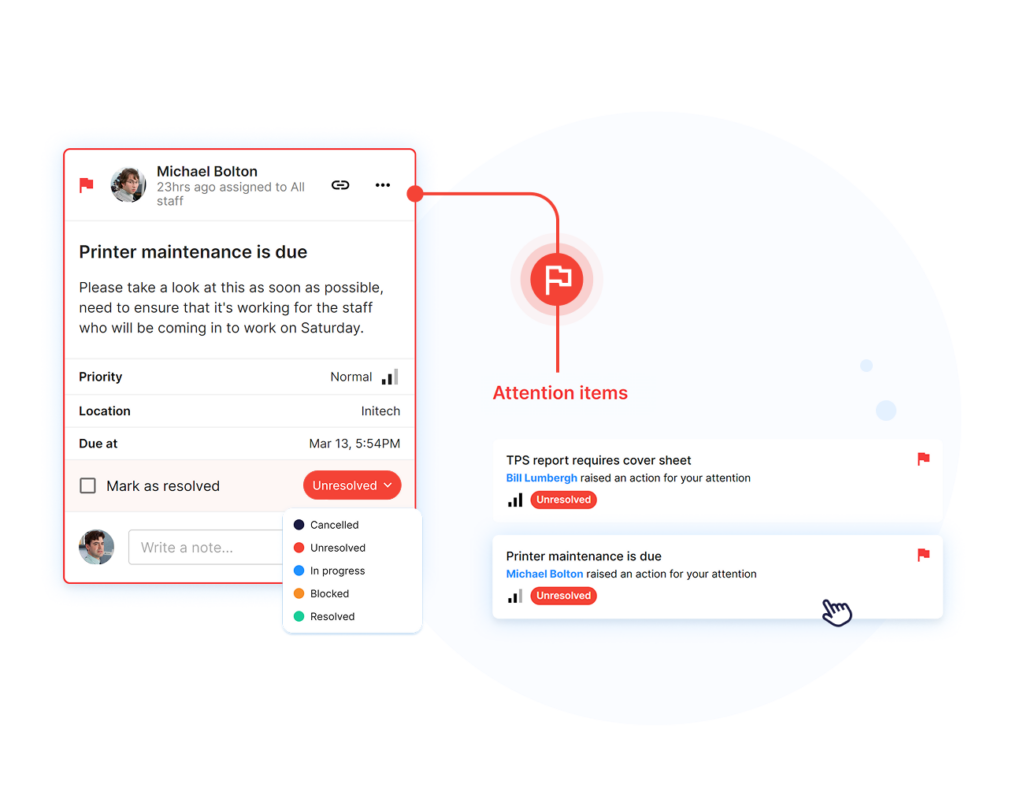
Measure effectiveness by tracking the time between finding raised → owner assigned. For high-risk food-safety findings, that gap should be close to zero.
Corrective Action 2: Set Deadlines According to Risk
Do not put a failed refrigerator temperature and a damaged floor tile into the same 30-day queue.
Use the finding classification to determine how quickly the location must contain the risk and provide evidence of correction.
For Priority-level food-safety problems, containment should happen immediately. Lower-risk facility or documentation findings can have a longer internal deadline.
HQ should also make escalation rules explicit before an action becomes overdue. A location manager might own the first deadline, with overdue items automatically moving to the district or regional manager.
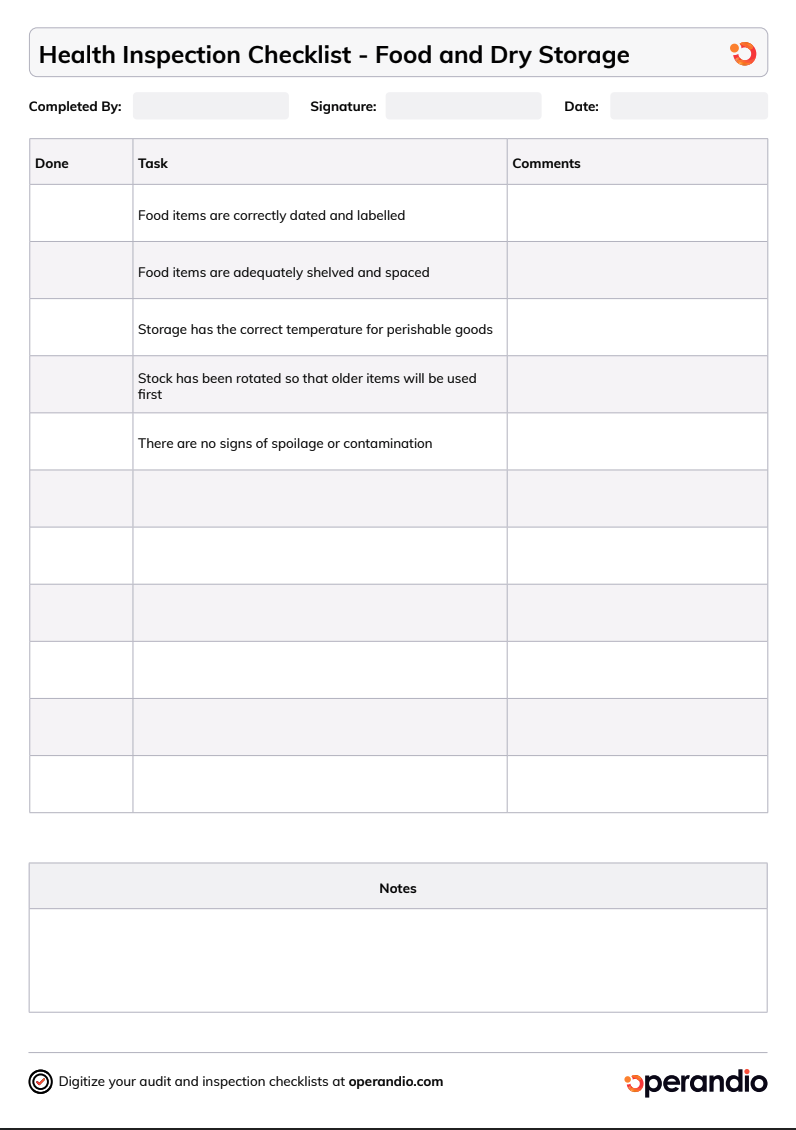
Need a starting audit form? Operandio’s restaurant inspection checklist template covers food storage, hygiene, handling, refrigeration, sanitation, waste, and pest control. Adapt the questions and scoring to your brand and local requirements.
Corrective Action 3: Require Evidence and Independent Verification
“Fixed” is not enough. Define what proof closes each type of finding. Depending on the issue, that could be:
- A photo
- Temperature reading
- Service or repair receipt
- Updated food-safety record
- Completed retraining
- Revised procedure
For higher-risk findings, someone other than the person completing the fix should verify the evidence.
Operandio lets locations attach photos, videos, comments, and files to corrective actions while maintaining an audit trail of who completed and verified the work.
Track first-time verification rate as well as closure speed. Actions that repeatedly bounce back because the evidence is incomplete are not being closed efficiently.
Corrective Action 4: Escalate Overdue and Repeated Findings
A corrective-action program should distinguish a late task from a recurring control failure.
Automatically escalate overdue high-risk actions so district or HQ teams can intervene before the next audit.
Then look for recurrence. If the same issue appears across two audits, run a root-cause review instead of assigning the same fix again.
For example, repeated cold-holding failures might point to equipment capacity, maintenance, loading practices, employee behavior, or an unrealistic monitoring process.
Operandio can surface recurring issues and hotspots across corrective actions, while the full audit trail shows who did what and when.
A useful HQ metric is repeat-finding rate: the percentage of closed findings that return in a defined number of subsequent audits. The goal is not simply to close actions faster, but to stop the same failures coming back.
Stay Audit-Ready Every Day, Not the Week Before
The records auditors ask for are created during normal operations. If temperature logs, HACCP checks, cleaning records, labels, training evidence, and corrective actions are captured as the work happens, HQ does not need locations rebuilding an audit trail before every visit.
Many restaurants are still doing that work manually. A 2026 report found that 46% record fridge and freezer temperatures manually in digital spreadsheets and 20% still use paper logs. Only 14% use automated IoT monitoring.
For a multi-location network, manual records also make it harder for HQ to see which site missed a check or where temperatures repeatedly drift out of range.
Operandio’s digital food safety platform brings digital HACCP workflows, automated temperature monitoring, food-prep labels, probe readings, and corrective actions into the same operational record.

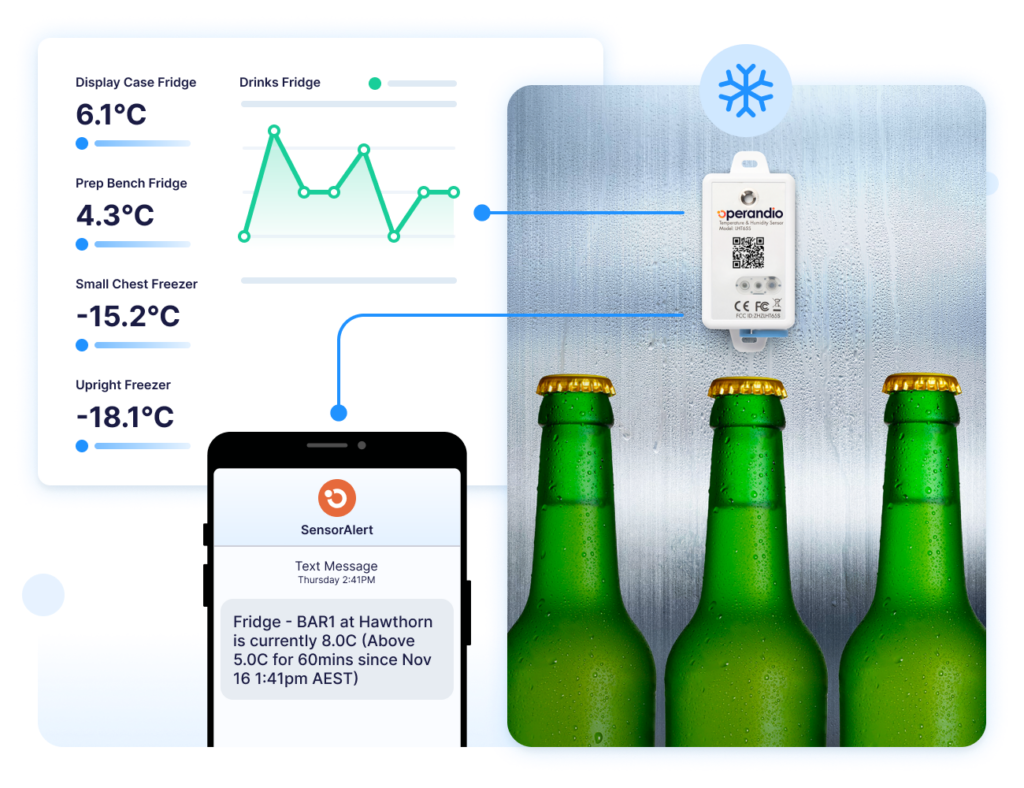
Wireless temperature monitoring can log fridge, freezer, and cold-room readings automatically and alert teams when equipment moves outside its defined range. Instead of preparing evidence for an audit, locations produce it continuously.
Run Every Location’s Food Safety Audits From One Place With Operandio
A network audit program works best when HQ can see the same standards, findings, evidence, and follow-up across every site.
Operandio brings food-safety audits, automated temperature monitoring, HACCP records, labeling, and corrective actions into one operations platform built for franchise and multi-unit businesses.
Super Chix uses Operandio across 60+ U.S. locations for digital audits, time-and-temperature monitoring, labeling, and remote oversight. It reports improved health department scores, while district managers use audit histories and network rankings to identify where stores need coaching.
“Being able to see the data remotely is very helpful. It gives our managers a lot more time to do their tasks instead of micromanaging the team,” says Lance Nebeker, Assistant Director of Operations at Super Chix
If you want to run one food-safety audit program across every location, request a demo today.
FAQs
How often should a restaurant have a food safety audit?
It depends. Set internal audit frequency according to food-handling risk, compliance history, previous findings, process complexity, and local regulatory requirements.
What is the difference between a food safety audit and a health inspection?
A food safety audit can be internal or privately commissioned. A health inspection is conducted by the responsible government regulatory authority.
What happens if a location fails a third-party food safety audit?
It depends on the program. The brand may require corrective actions, additional training, escalation, or a follow-up audit against defined deadlines.
What documents do food safety auditors ask for?
Common records include temperature logs, cleaning records, training certificates, pest-control reports, maintenance records, HACCP documentation, and previous corrective actions.
Does the 2026 FDA Food Code change food safety audits?
Yes, where jurisdictions adopt it. The model adds requirements including a written employee illness policy and, for covered establishments, a written FSMS.