
- Platform
- Features
 Franchise & Multi-Unit ManagementCentralize oversight and streamline growth across your entire multi location network
 Learning ManagementTrain, verify, and reward your workforce with mobile-first education
 Operations ExecutionStreamlined operations ensuring brand standards, accountability and efficiency
 Asset ManagementOptimize equipment uptime through proactive maintenance and smart tracking
 Digital Food SafetyAutomate compliance and monitor quality with real-time digital precision
 Health & Safety Management (EHS)Mitigate workplace risks and streamline digital incident reporting and investigations
- Platform Essentials
 Powerful ReportingAlign leadership with role-based dashboards and deeper analytics
 Operandio IntelligenceAutomate content, analyze trends, and provide instant answers
 IntegrationsUnify your enterprise tech stack with real-time data
 IoT PlatformDetect anomalies and automate workflows with intelligent sensors
 Mobile & Shared Tablet AppsSecurely empower frontline teams with fast, offline-capable access
- Footer


 Not sure what you need?
Book in a call with the team
- Features
- Solutions
- By Industry
 RestaurantsQSR, fast food and multi-unit restaurants
 Hotels & ResortsHotels, resorts and extended stay hotels
 ChildcareEarly education, childcare, daycare and preschool
 EntertainmentTheme parks, family entertainment centers and play centers
 Fitness Centers & LeisureFitness centers, golf clubs, gyms and sports facilities
 RetailBig-box retailers, franchise stores and supermarkets
- By Use Case
- Operational ExcellenceStreamlined operations ensuring brand standards, accountability and efficiency
- Learning & DevelopmentTrain, verify, and reward your workforce with mobile-first education
- Franchise & Multi-Unit ManagementCentralize oversight and streamline growth across your entire multi location network
- Food Safety ComplianceAutomate compliance and monitor quality with real-time digital precision
- Asset Management & MaintenanceOptimize equipment uptime through proactive maintenance and smart tracking
- Health & Safety Management (EHS)Mitigate workplace risks and streamline digital incident reporting and investigations
- By Industry
- Resources
- Platform
- Features
- Franchise & Multi-Unit ManagementCentralize oversight and streamline growth across your entire multi location network
- Learning ManagementTrain, verify, and reward your workforce with mobile-first education
- Operations ExecutionStreamlined operations ensuring brand standards, accountability and efficiency
- Asset ManagementOptimize equipment uptime through proactive maintenance and smart tracking
- Digital Food SafetyAutomate compliance and monitor quality with real-time digital precision
- Health & Safety Management (EHS)Mitigate workplace risks and streamline digital incident reporting and investigations
- Platform Essentials
- Powerful ReportingAlign leadership with role-based dashboards and deeper analytics
- Operandio IntelligenceAutomate content, analyze trends, and provide instant answers
- IntegrationsUnify your enterprise tech stack with real-time data
- IoT PlatformDetect anomalies and automate workflows with intelligent sensors
- Mobile & Shared Tablet AppsSecurely empower frontline teams with fast, offline-capable access
- Footer
- Not sure what you need?
Book in a call with the team
- Features
- Solutions
- By Industry
- RestaurantsQSR, fast food and multi-unit restaurants
- Hotels & ResortsHotels, resorts and extended stay hotels
- ChildcareEarly education, childcare, daycare and preschool
- EntertainmentTheme parks, family entertainment centers and play centers
- Fitness Centers & LeisureFitness centers, golf clubs, gyms and sports facilities
- RetailBig-box retailers, franchise stores and supermarkets
- By Use Case
- Operational ExcellenceStreamlined operations ensuring brand standards, accountability and efficiency
- Learning & DevelopmentTrain, verify, and reward your workforce with mobile-first education
- Franchise & Multi-Unit ManagementCentralize oversight and streamline growth across your entire multi location network
- Food Safety ComplianceAutomate compliance and monitor quality with real-time digital precision
- Asset Management & MaintenanceOptimize equipment uptime through proactive maintenance and smart tracking
- Health & Safety Management (EHS)Mitigate workplace risks and streamline digital incident reporting and investigations
- By Industry
- Resources
Why & How to Use AI for Employee Training and Development
Key Takeaways
- AI for employee training applies machine learning and natural language processing to personalize content, automate course creation, and deliver learning at scale across dispersed teams.
- AI-driven personalized learning increases employee engagement by 30% and improves learning outcomes by 25%
- The highest-impact use cases are automated content creation, personalized learning paths, adaptive assessments, and multilingual delivery.
- To get the most from AI training tools, start by mapping them to a specific skill gap, keep training inside the same platform your teams use daily, and review every AI-generated course before it goes live.
Traditional employee training is hard to build and harder to track consistently across multiple locations.
Without proper tracking, completion rates stay low, skill gaps go undetected, and content falls out of date faster than anyone can update it.
That’s why you need AI for employee training to address each of those problems directly.
In this article, we’ll cover how to apply AI across the training lifecycle, which technologies to rely on, and how multi-location businesses can get started in 2026.
How is AI Used in Employee Training?

AI for employee training refers to the use of artificial intelligence to build, deliver, and measure learning programs in the workplace.
It covers automated course creation, adaptive learning paths, AI-assisted translation, chatbot-based knowledge access, and analytics that surface skill gaps before they affect performance.
Here’s how AI employee training differs from traditional training:
| Traditional Training | AI-Powered Training | |
| Content creation | Manual: takes weeks to produce | AI-generated in minutes |
| Delivery | Fixed schedule; PDF or classroom | Mostly mobile-first, self-paced, and adaptive |
| Personalization | Same content for all roles | Tailored to role, skill level, and gaps |
| Assessment | End-of-module quiz; pass or fail | Ongoing; targets the areas where knowledge is weakest |
| Analytics | Completion rates only | Tracks knowledge gaps and skill trends over time |
| Translation | Separate manual process | Automated, multi-language delivery |
Operandio’s Learning & Development platform is built around the AI-powered column above. See how it works for multi-location teams.
How Can AI Improve Employee Training: Benefits and Use Cases?
Applying AI to the right areas of your training program produces measurable gains in output speed and learning quality.
The four use cases below represent the points where AI creates the largest operational difference.
1: AI-Powered Course and Content Creation
Research from Murf.ai found that 48% of L&D professionals cite time constraints as the biggest barrier to creating and delivering effective training.
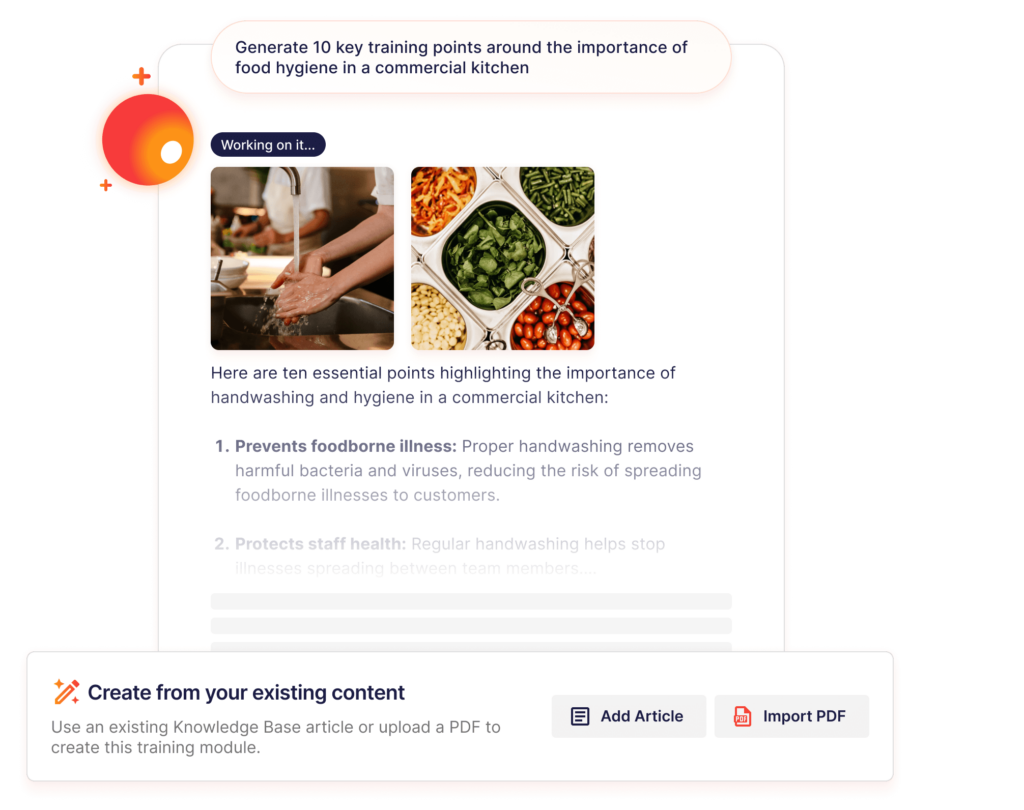
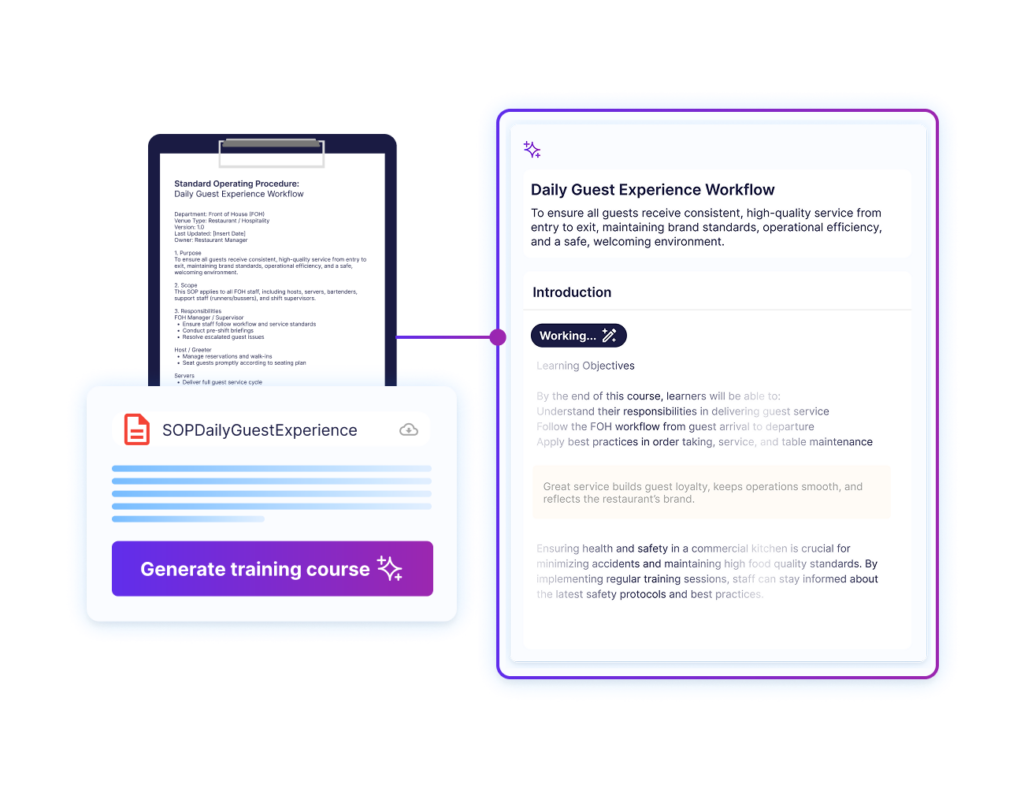
AI removes that barrier by generating structured course content, quizzes, and assessments from a document, a URL, or a short prompt.
Here’s how Operandio’s AI-powered course builder turns existing documents and procedures into fully structured courses within minutes.
2: Personalized Learning Paths
Standard training programs assign the same content to every employee regardless of role or existing knowledge. This produces learners who skip through material they already know while missing the gaps that affect their actual work.
AI addresses this by analyzing quiz results, completion history, and job role to recommend the next most relevant module for each individual.
According to Virtual Speech, AI-driven personalized learning increased employee engagement by 30% and improved learning outcomes by 25%. On top of that, learning efficiency increases by 57% when AI-tailored learning paths are implemented.
3: Adaptive Assessments and Knowledge Checks
A pass/fail quiz at the end of a module does not confirm that an employee has retained training or can apply it.
So, adaptive assessments use AI to adjust question difficulty based on how a learner is performing in real time, targeting the areas where knowledge is weakest. Combined with physical workplace assessments, teams can verify both theoretical understanding and hands-on skills.
4: Multilingual Training Delivery
Frontline workforces are frequently multilingual, and requiring all employees to train in a single language raises dropout rates and reduces retention. Building separate translated versions for each language is also expensive and hard to keep current.
To solve that, AI translation embedded in a training platform renders course content in a learner’s preferred language without a separate workflow.
Tip: You can use Operandio’s AI-powered translation to make courses available to every team member in the language they work in.
What AI Technology Can Improve Employee Training?
Several distinct AI capabilities are applied in training platforms, and each one addresses a different problem. Understanding what each does helps businesses choose the right tools rather than investing in technology that does not fit their use case.
| AI Technology | Uses |
| Machine Learning (ML) | Adjusts each employee’s learning path based on how they interact with content Flags who is falling behind a competency target |
| Natural Language Processing (NLP) | Powers the AI’s ability to read source material and produce training content from it, including in other languages |
| Generative AI | Turns a document or procedure into a structured course |
| Predictive Analytics | Spots compliance gaps and skill shortfalls before they show up in audit results or on the floor |
1. Machine Learning
Machine learning allows an LMS training platform to adapt to each employee rather than following a fixed sequence.
The system builds a behavioral model from quiz results and content interaction patterns, then updates it continuously as the learner progresses. Difficulty and sequencing shift based on where each person actually is, not where the course assumes they should be.
Over time, the platform gets better at catching gaps that a fixed curriculum would miss.
2. Natural Language Processing (NLP)
NLP allows AI to parse the meaning of text. In a training context, it enables a platform to take an existing procedure document and generate structured course content.
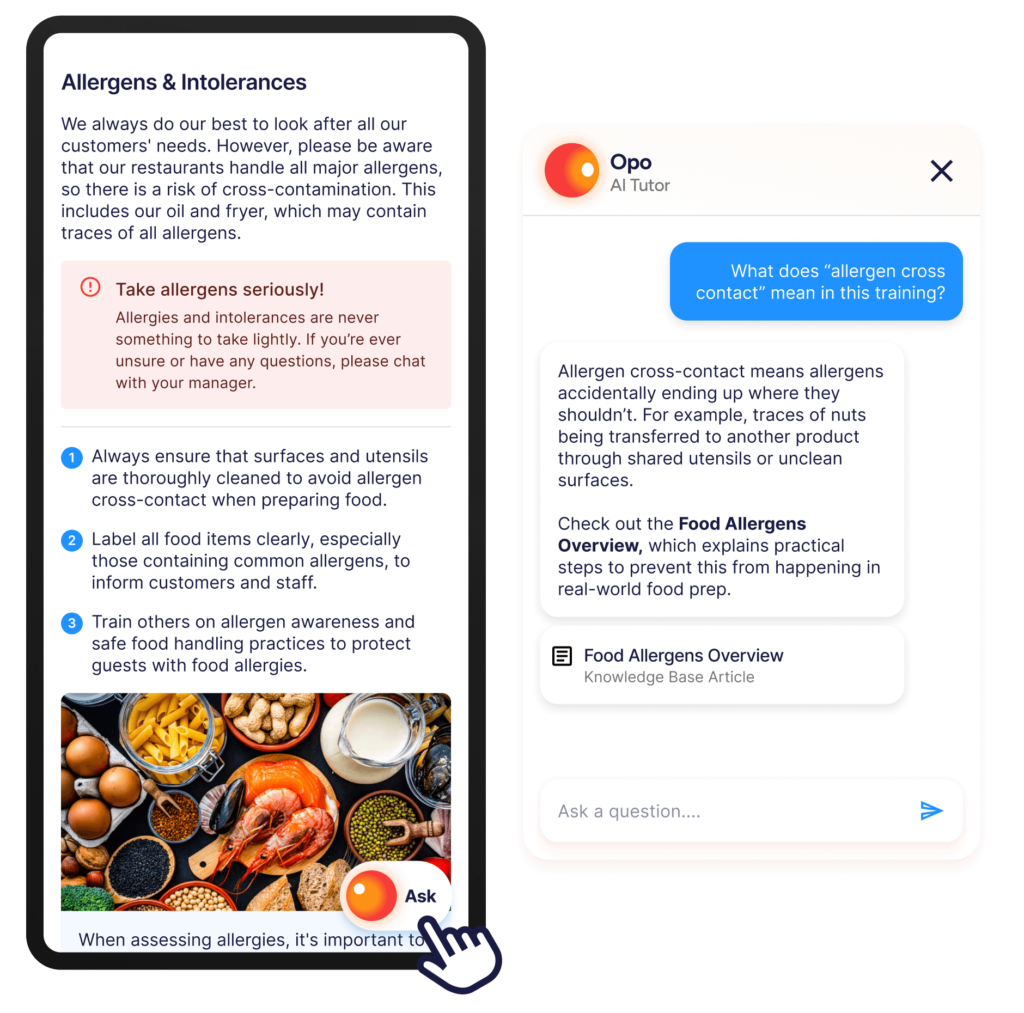
The same capability drives automated translation and powers in-platform search. Rather than navigating folders of static documents, employees type a question and receive a direct answer drawn from the organization’s own knowledge base.
Here’s how Operandio also helps franchises maintain a knowledge base and navigate it with NLP.
3. Generative AI
Generative AI handles the content production side of training. Given a document or a described procedure, it produces quiz questions, lesson summaries, and scenario-based exercises.
The practical implication is that training content no longer depends on a long production cycle. When a process changes, a new course version can be drafted the same day rather than waiting on an instructional designer’s schedule.
Learning management systems built around generative AI allow organizations to keep training aligned with how work is actually done, rather than running months behind during periods of change.
4. Predictive Analytics
Predictive analytics uses historical training data to forecast future outcomes. Rather than reporting what has already happened, it tells you what is likely to happen next.
A platform can flag that a specific location is trending toward a compliance gap two weeks before any deadline is missed, or identify which employees are at risk of dropping out of a training path before they do.
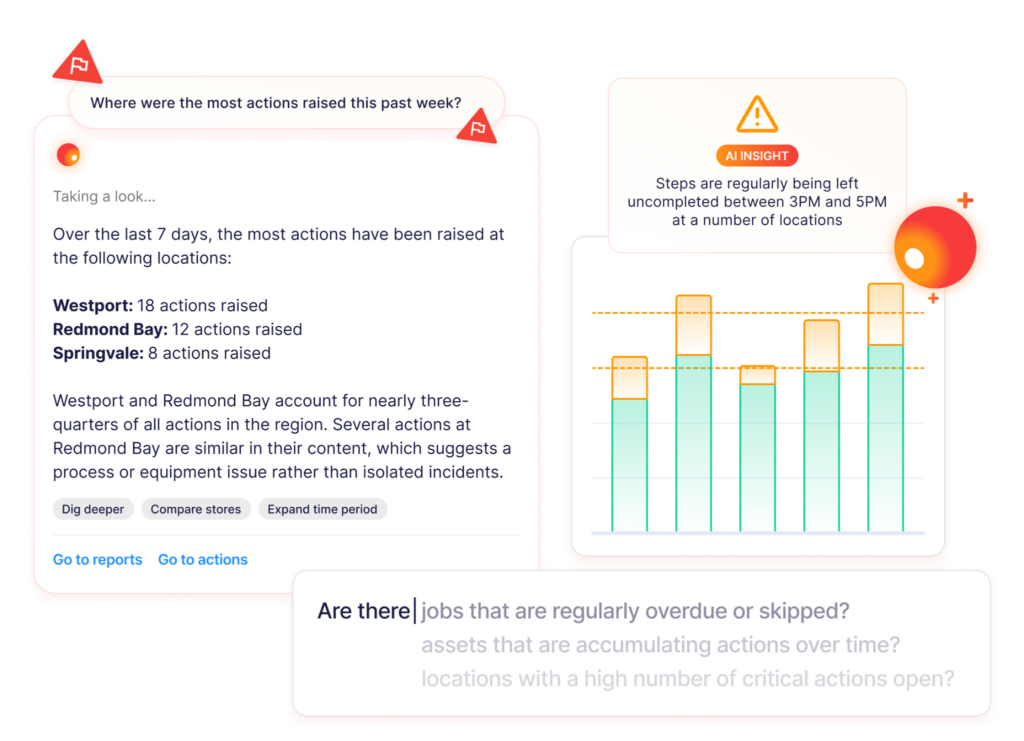
Operandio’s powerful reporting tools surface this data at both the individual and network level, giving leadership the visibility to act on training trends across every site.
Why Should You Use AI for Employee Training?
AI training tools deliver real operational value when they are set up with a clear purpose. The benefits below reflect what multi-location businesses consistently see when AI training is deployed with defined objectives.
1. Faster Onboarding Without More Manager Time
New employee onboarding is one of the most resource-intensive training activities in any frontline operation. Managers spend hours walking new hires through content that could be covered independently before a first shift.
For a business opening new locations or managing high seasonal turnover, that gain accumulates fast.
Utilizing a mobile-first employee onboarding LMS allows AI-generated onboarding modules cover safety procedures and job-specific tasks on any device, including shared tablets, before a new hire starts.
2. Higher Retention Through Consistent Development
A LinkedIn report shows companies with a strong learning culture retain employees at a 57% higher rate than those with only moderate learning investment. For frontline businesses where turnover is a recurring cost, that gap has direct financial consequences.
AI-powered learning paths keep employees progressing after onboarding by automatically surfacing new modules tied to their role. Managers do not manually identify and assign development content.
Using badges, pathways, and certificates tied to AI-driven paths gives employees a visible record of growth, which research consistently links to both higher engagement and lower attrition.
3. Compliance Tracking Across Multiple Locations
Confirming that every employee at every location has completed the right training at the right time is one of the hardest operational challenges in any multi-unit business. Manual tracking through spreadsheets does not scale and is easy to miss.
An AI-enabled platform tracks completion automatically, sends reminders for overdue training, and flags gaps at both the individual and location level.
The purpose of a learning management system in this context goes beyond storing courses. It becomes the audit trail that demonstrates training was delivered, completed, and assessed across the whole network.
How Can Businesses Get the Most Out of AI in Employee Training Programs?
AI does not replace a training strategy. It executes one.
The businesses that see the most from AI training tools go in with clear objectives and a platform that connects training to the rest of their operations.
1. Map AI to Specific Skill Gaps First
The most common failure mode in AI training rollouts is deploying tools before defining what problem they are solving. Businesses invest in a platform, push out content, and measure completion rates, but not whether training closed any real gap.
Before building courses or selecting a platform, identify the one or two highest-impact skill gaps in your workforce. These might be onboarding speed at new sites or compliance completion across existing locations.
Once the gap is defined, you configure AI tools to target it rather than generating generic content that runs in the background.
2. Keep Training Connected to Daily Operations
AI training that lives in a separate tool from daily operations creates an adoption problem.
Employees rarely return to platforms they only opened during onboarding, and managers do not monitor training progress without a prompt from the system they are already using.
The advantages of combining LMS with an operations platform are practical: when training sits inside the same platform as task management and audits, it becomes part of the daily workflow.
And, training triggered by an audit finding or a procedure update can be assigned, completed, and tracked in the same place where the rest of the operation runs.
See how Operandio’s AI-powered tools connect learning directly to operations execution.
3. Build Human Review Into the AI Content Workflow
Generative AI produces training content fast, but it needs oversight before it reaches your teams.
Errors in safety content create real liability, and AI-generated material sometimes lacks the operational specificity that makes training meaningful in your particular context.
Build a review step into every AI-generated course before publishing, where a subject matter expert verifies procedural accuracy and confirms that content reflects your actual operating standards.
Once approved, the course publishes to all relevant locations in one action.
Train Your Multi-Location Frontline Teams with Operandio’s AI-Powered Tools
Most training programs stall because content is slow to build and delivery is inconsistent across sites. Operandio brings AI course creation, adaptive assessments, and compliance tracking into a single platform built for multi-unit teams.
Ready to put AI training into practice? Start with the best AI LMS platforms guide to compare your options. And, see how Operandio helps multi-franchise businesses manage training and operations in one place, then book a demo to get set up.
FAQs
1. Is AI training effective compared to traditional methods?
Yes. Digital training is 93.7% more effective at helping employees meet organizational expectations. AI-driven personalized learning adds a 25% improvement in learning outcomes over standard course delivery.
2. Can AI replace corporate trainers?
No. AI handles content creation, personalization, and tracking, but trainers are still needed for leadership development and complex skills that require human judgment. The strongest programs use AI to handle repeatable tasks so trainers can focus on higher-value development work.
3. How is AI used in learning and development today?
AI is used in L&D for automated course creation, personalized learning path recommendations, adaptive assessments, multilingual content delivery, and predictive analytics that identify skill gaps and forecast dropout risk before they affect operational performance.
4. Does AI training work for frontline and deskless workers?
Yes. Mobile-first AI training platforms like Operandio are built for deskless workers. Short-form modules, shared tablet access, and offline capability make AI training accessible for any frontline environment, from QSR kitchens to hotel operations teams.